
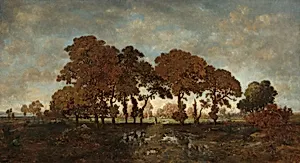
After the Rain
c. 1850
Medium
oil on canvas
Dimensions
overall: 78.74 × 146.05 cm (31 × 57 1/2 in.) framed: 96.52 × 162.88 × 9.21 cm (38 × 64 1/8 × 3 5/8 in.)
Classification
Painting
Department
CF
Museum
National Gallery of Art, Washington, D.C.
Credit
Corcoran Collection (William A. Clark Collection)
Accession Number
2014.136.43
Rights
Public Domain
Art Historical Context
Théodore Rousseau, a leading figure of the Barbizon School, created *After the Rain* around 1850 as part of his lifelong dedication to capturing the unspoiled beauty of the French countryside. Rejecting the idealized landscapes of academic tradition, Rousseau and his fellow artists painted outdoors directly from nature, emphasizing honest observation over studio invention. This large oil on canvas reflects that commitment, presenting a sweeping vista likely inspired by the Forest of Fontainebleau, where Rousseau spent much of his career. The medium of oil allowed Rousseau to build rich layers of pigment that convey the glistening freshness of the landscape after a storm. Subtle shifts in light and atmosphere highlight his technical skill in rendering moisture-laden skies, reflective earth, and vibrant foliage. Measuring over five feet wide, the painting invites viewers to immerse themselves in its tranquil mood, evoking the quiet renewal that follows rain. Today housed in the National Gallery of Art as part of the Corcoran’s William A. Clark Collection, *After the Rain* stands as a testament to the Barbizon movement’s lasting influence on modern landscape painting and the rise of Realism.
About the Artist
Théodore Rousseau · 1812–1867
Théodore Rousseau (1812–1867) was a French landscape painter and the leading figure of the Barbizon School, the group of artists who settled in the village of Barbizon near the Forest of Fontainebleau to paint directly from nature. Born in Paris, he showed precocious talent and studied under the academic painters Charles Rémond and Guillaume Guillon-Lethière, but quickly rejected classical landsca...