
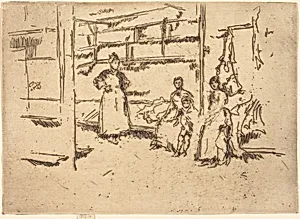
After the Sale, Hounsditch
c. 1886/1888
Medium
etching on laid paper
Dimensions
overall (trimmed to plate): 12.6 × 17.7 cm (4 15/16 × 6 15/16 in.)
Classification
Department
CG-W
Museum
National Gallery of Art, Washington, D.C.
Credit
Rosenwald Collection
Accession Number
1943.3.8597
Rights
Public Domain
Art Historical Context
James McNeill Whistler’s *After the Sale, Hditch* (c. 1886/1888) captures a poignant slice of late Victorian London life in the impoverished East End neighborhood of Houndsditch. This etching depicts the aftermath of an auction sale, with weary horses and figures huddled amid the debris of everyday struggle, evoking the gritty realism of urban poverty. Whistler, an American expatriate celebrated for his Aesthetic Movement ideals—prioritizing "art for art’s sake"—often explored tonal harmony and subtle mood over narrative detail, aligning this work with his masterful etching series inspired by the Thames and working-class districts. Printed on laid paper, the medium exemplifies Whistler’s technical prowess in etching, a process where acid etches intricate lines into a metal plate for multiple impressions. Trimmed to its plate size of 12.6 × 17.7 cm, the intimate scale draws viewers into its atmospheric depth, achieved through delicate drypoint burrs and aquatint for velvety textures. Part of the National Gallery of Art’s Rosenwald Collection, it reflects the Etching Revival of the 19th century, where artists like Whistler elevated printmaking to fine art. This piece not only showcases Whistler’s innovative subtlety—often compared to Whistler’s famous nocturnes—but also offers a window into social contrasts of 1880s London, blending beauty with quiet social commentary for enduring resonance.
About the Artist
James McNeill Whistler · 1834–1903
James Abbott McNeill Whistler (1834-1903) was an American-born painter and printmaker who became a leading figure in the Aesthetic Movement and pioneer of Tonalism and Japonisme. He revolutionized art by championing "art for art's sake" and treating paintings as visual equivalents of musical compositions, titling works as "arrangements," "harmonies," and "nocturnes" to emphasize formal qualities o...