
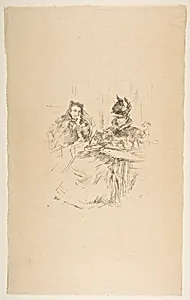
Afternoon Tea
Medium
Transfer lithograph with stumping; only state (Chicago); printed in black ink on tan laid Japnese vellum
Dimensions
Image: 7 3/8 × 6 1/4 in. (18.7 × 15.8 cm) Sheet: 15 11/16 × 9 1/2 in. (39.8 × 24.1 cm)
Classification
Prints
Department
Drawings and Prints
Museum
Metropolitan Museum of Art, New York, NY
Credit
Harris Brisbane Dick Fund, 1917
Accession Number
17.3.255
Rights
Public Domain
Tags
Art Historical Context
James McNeill Whistler’s *Afternoon Tea* (1897) captures a quiet moment of social ritual with characteristic subtlety and elegance. Created late in the artist’s career, the print reflects Whistler’s lifelong fascination with everyday scenes rendered through refined tonal effects rather than narrative detail. The composition shows men and women gathered around a tea table, evoking the intimate domestic customs of the late Victorian era while emphasizing atmosphere over anecdote. Executed as a transfer lithograph with stumping on tan Japanese vellum, the work highlights Whistler’s mastery of printmaking. Lithography allowed him to achieve the soft, velvety gradations seen in the figures’ clothing and the table setting, while the delicate paper enhances the image’s luminous quality. As one of only a small number of impressions in this state, the print demonstrates Whistler’s experimental approach to the medium during a period when he was exploring its expressive possibilities alongside his more famous etchings and paintings. Beyond its technical finesse, *Afternoon Tea* offers a glimpse into the refined social world Whistler often observed with detached wit. The restrained composition and muted tones invite viewers to appreciate the quiet beauty of ordinary moments, embodying the Aesthetic Movement’s belief in art’s capacity to elevate the everyday.
About the Artist
James McNeill Whistler · 1834–1903
James Abbott McNeill Whistler (1834-1903) was an American-born painter and printmaker who became a leading figure in the Aesthetic Movement and pioneer of Tonalism and Japonisme. He revolutionized art by championing "art for art's sake" and treating paintings as visual equivalents of musical compositions, titling works as "arrangements," "harmonies," and "nocturnes" to emphasize formal qualities o...