
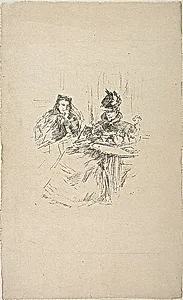
Afternoon Tea
Medium
Transfer lithograph in black on tan laid Japanese vellum
Dimensions
Image: 18.5 × 15.7 cm (7 5/16 × 6 3/16 in.); Sheet: 40 × 24.3 cm (15 3/4 × 9 5/8 in.)
Classification
transfer lithograph
Department
Prints and Drawings
Museum
Art Institute of Chicago
Accession Number
139560
Rights
Public Domain
Art Historical Context
James McNeill Whistler’s *Afternoon Tea* (7) captures an intimate moment of Victorian domesticity through the delicate medium of transfer lithography. Printed in black ink on tan laid Japanese vellum—a fine, textured paper prized for its absorbency and subtle sheen—this work exemplifies Whistler’s mastery of printmaking in his later career. The modest image size (18.5 × 15.7 cm) invites close viewing, revealing his signature focus on harmony, tone, and suggestion over detail, hallmarks of the Aesthetic movement he championed. Whistler, an American expatriate in London, revolutionized printmaking with transfer lithography, a technique where drawings on paper are chemically transferred to a lithographic stone for editioning. This allowed fluid, painterly effects akin to his famous oil paintings, like the ethereal *Nocturnes*. Produced during a prolific phase of urban and interior scenes, *Afternoon Tea* evokes the refined ritual of British high tea, blending everyday elegance with Japanese influences evident in the vellum and Whistler’s lifelong admiration for ukiyo-e prints. Housed in the Art Institute of Chicago’s Prints and Drawings department, this sheet (40 × 24.3 cm) highlights Whistler’s belief in “art for art’s sake,” prioritizing mood and beauty. It remains a testament to how 19th-century innovations in lithography democratized fine art, bridging elite painting traditions with accessible multiples.
About the Artist
James McNeill Whistler · 1834–1903
James Abbott McNeill Whistler (1834-1903) was an American-born painter and printmaker who became a leading figure in the Aesthetic Movement and pioneer of Tonalism and Japonisme. He revolutionized art by championing "art for art's sake" and treating paintings as visual equivalents of musical compositions, titling works as "arrangements," "harmonies," and "nocturnes" to emphasize formal qualities o...