
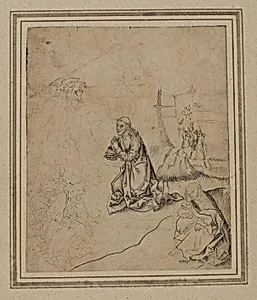
Agony in the Garden
ca. 1500
Medium
Pen and brush and grayish black ink.
Dimensions
7 1/2 x 6 5/16 in. (19.1 x 16 cm)
Classification
Drawings
Culture
German, Franconia
Department
Robert Lehman Collection
Museum
Metropolitan Museum of Art, New York, NY
Credit
Robert Lehman Collection, 1975
Accession Number
1975.1.850
Rights
Public Domain
Tags
Art Historical Context
Nestled in the Robert Lehman Collection at The Metropolitan Museum of Art,Agony in the Garden is a poignant drawing from Franconia, Germany, circa 1500. This work captures the biblical moment when Christ prays in the Garden of Gethsem, sweating blood in anticipation of his crucifixion—a scene central to Christian devotion during the late Gothic period. Created by an anonymous German artist, it reflects the emotional intensity and spiritual focus of Northern European art at the cusp of the Renaissance, where religious subjects like the Passion of Christ inspired both public altarpieces and private meditations. Executed in pen and brush with grayish black ink on a modest scale (7 1/2 x 6 5/16 inches), the drawing showcases the meticulous line work and subtle tonal modeling typical of 15th-century draftsmen. The grayish ink allows for delicate shading, evoking depth and drama in a compact format ideal for sketchbooks or personal study. Such techniques highlight the artist's skill in conveying anguish and divine solitude without color, emphasizing line as the primary emotional tool. This Franconian gem underscores the cultural reverence for Christ's humanity in pre-Reformation Germany, where drawings served as devotional aids or preparatory works. Its survival into the 20th century, acquired in 1975, offers visitors a window into the era's artistic humility and profound faith.
About the Artist
German
**German, Franconia (active ca. 1485–1500)** was an anonymous artist from the Franconian region of northern Bavaria, Germany, renowned for his contributions to late Gothic graphic arts. Little is known of his early life or training, as details about many anonymous masters from this era remain undocumented. Franconia, with its vibrant artistic centers like Nuremberg, fostered a rich tradition of re...