
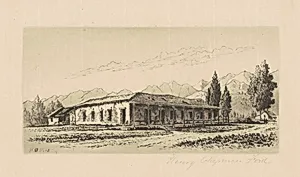
Aguirre House (Santa Barbara)
c. 1880
Medium
etching in black on laid paper
Dimensions
image: 10 × 20.16 cm (3 15/16 × 7 15/16 in.) plate: 14.29 × 24.29 cm (5 5/8 × 9 9/16 in.) sheet: 27.78 × 39.69 cm (10 15/16 × 15 5/8 in.)
Classification
Department
CG-W
Museum
National Gallery of Art, Washington, D.C.
Credit
Corcoran Collection (Gift of Alice F. Williams)
Accession Number
2015.19.929
Rights
Public Domain
Art Historical Context
Henry Chapman Ford's *Aguirre House ( Barbara)*, created around 1880, captures the of California's Spanish colonial architecture through the delicate medium of etching. Ford, a prominent American artist and member of the late-19th-century etching revival, traveled extensively in the American West, documenting historic adobes and missions with meticulous line work. This print depicts the Aguirre House, a storied Santa Barbara residence emblematic of the region's Mexican-era heritage, blending rustic adobe walls with ornate details that evoke California's fading frontier past. Etching on laid paper allowed Ford to achieve intricate textures and atmospheric depth, as acid etched fine lines into a metal plate, producing rich blacks and subtle tones. Measuring just 10 × 20.16 cm in its image area, the intimate scale invites close viewing, highlighting Ford's skill in rendering architectural nuances—shadowed doorways, textured surfaces, and distant landscapes—on a modest sheet. Now part of the National Gallery of Art's Corcoran Collection, this work preserves a slice of Santa Barbara's cultural history, underscoring Ford's role in romanticizing and safeguarding the Southwest's architectural legacy for future generations. A testament to printmaking's power, it bridges art and preservation in an era of rapid American expansion.