
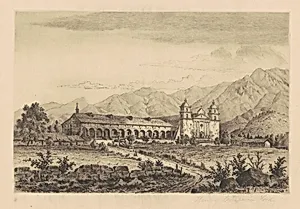
Mission Santa Barbara
Medium
etching in black on laid paper
Dimensions
plate: 20.16 × 30.32 cm (7 15/16 × 11 15/16 in.) sheet: 32.07 × 44.13 cm (12 5/8 × 17 3/8 in.)
Classification
Department
CG-W
Museum
National Gallery of Art, Washington, D.C.
Credit
Corcoran Collection (Gift of Alice F. Williams)
Accession Number
2015.19.934
Rights
Public Domain
Art Historical Context
Henry Chapman Ford's *Mission Santa Barbara* (1883) captures the serene grandeur of one of California's most iconic Spanish colonial landmarks. Founded in 1786 by Franciscan missionaries, the "Queen of the Missions" stands as a testament to early European settlement in Alta California, blending Baroque architecture with practical adobe construction. Ford, an American artist renowned for his meticulous documentation of these historic sites, created this etching during his travels through the region in the 1880s, preserving their fading splendor amid rapid American expansion. Rendered as a black etching on laid paper, the work exemplifies the 19th-century etching revival, a technique where acid etches intricate lines into a metal plate for richly textured prints. Ford's precise lines convey the mission's twin bell towers, arched walkways, and sunlit facade with remarkable fidelity, evoking a sense of timeless tranquility. Measuring about 8 by 12 inches on the plate, this intimate yet detailed view allowed wide dissemination of California's cultural heritage. Now part of the National Gallery of Art's Corcoran Collection, Ford's etching highlights the intersection of art and preservation, offering visitors a window into the missions' enduring legacy.