
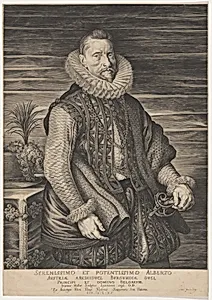
Albert, Archduke of Austria
Medium
engraving
Dimensions
sheet: 41.5 × 29.2 cm (16 5/16 × 11 1/2 in.)
Classification
Department
CG-E
Museum
National Gallery of Art, Washington, D.C.
Credit
Rosenwald Collection
Accession Number
1950.14.7
Rights
Public Domain
Art Historical Context
This striking engraving, *Albert, Archduke of Austria*, created by Jan Muller after a design by the renowned Baroque master Sir Peter Paul Rubens in 1615, captures dignified likeness of Albert VII, co-sovereign of the Habsburg. Measuring 41.5 × 29.2 cm, it hails from the National Gallery of Art's Rosen Collection and exemplifies the collaborative artistry of the early 17th century where Rubens' dynamic compositions were faithfully translated into print by skilled engravers like Muller. As a key figure in the Spanish Netherlands, Archduke Albert ruled alongside his wife, Isabella Clara Eugenia, from 1598 to 1621, fostering a cultural renaissance amid religious and political strife. Rubens, his court painter, infused the portrait with Baroque grandeur—likely featuring rich drapery, expressive features, and a sense of regal authority that symbolized Habsburg power. Engravings like this were revolutionary for their time, enabling mass reproduction and dissemination of elite imagery across Europe, turning royal portraits into tools of propaganda and prestige. Muller's meticulous technique—incising fine lines into a copper plate with acid—preserved Rubens' vibrant style in intricate detail, from textures of armor to subtle shading. This print not only honors a pivotal ruler but also highlights printmaking's role in democratizing high art, inviting viewers to connect with history's grandeur.