
Justus Lipsius
1587
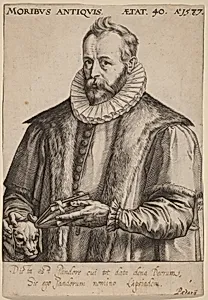
Medium
engraving on laid paper
Dimensions
overall: 14 x 9.6 cm (5 1/2 x 3 3/4 in.)
Classification
Department
CG-E
Museum
National Gallery of Art, Washington, D.C.
Credit
Ailsa Mellon Bruce Fund
Accession Number
2000.30.2
Rights
Public Domain
Art Historical Context
Behold Hendrik Goltzius's engraving *Justus Lipsius* (1587), a compact yet striking portrait measuring just 14 x 9.6 cm, crafted on laid paper. This intimate print captures the Flemish philosopher and philologist Justus Lips, a towering figure of the Northern Renaissance whose neo-Stoic writings influenced thinkers across Europe during a time of religious turmoil and intellectual ferment. Goltzius, a leading Dutch Mannerist engraver, showcases his virtuosic technique here, employing a swelling line that mimics the fluid brushstrokes of painting. This innovative approach in intaglio printmaking allowed for remarkable tonal depth and three-dimensionality on a small scale, elevating engraving from mere reproduction to high art. Produced amid the Dutch Revolt, the work reflects the era's humanist reverence for classical scholarship, immortalizing Lipsius as a beacon of moral philosophy. Housed in the National Gallery of Art through the Ailsa Mellon Bruce Fund, this print exemplifies Goltzius's role in bridging painting and print culture, making elite portraiture accessible to collectors and scholars alike. A testament to 16th-century ingenuity, it invites us to ponder Lipsius's enduring call for resilience in uncertain times.
About the Artist
Hendrik Goltzius
Hendrick Goltzius (1558–1617), born near Viersen in the Duchy of Jülich (modern Germany), emerged as the preeminent Dutch engraver of the Northern Mannerist era. From a lineage of artists—his great-grandfather and grandfather were painters in Venlo, and his father, Jan Goltz II, a glass painter—Goltzius began his training under his father in painting on glass. A childhood fire severely deformed hi...