
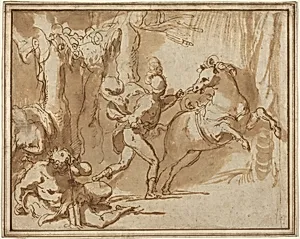
Alexander the Great and Bucephalus
c. 1553
Medium
pen and brown ink with brown wash over traces of graphite on laid paper
Dimensions
overall: 19.4 x 24.1 cm (7 5/8 x 9 1/2 in.)
Classification
Drawing
Department
CG-E
Museum
National Gallery of Art, Washington, D.C.
Credit
Woodner Collection
Accession Number
1991.182.1
Rights
Public Domain
Art Historical Context
Taddeo Zuccaro’s drawing captures the legendary moment when the young Alexander the Great tamed the fierce horse Bucephalus, a story symbolizing courage, destiny, and the bond between ruler and steed. Created around 1553, this small sheet reflects the Renaissance fascination with classical antiquity and heroic narratives drawn from Plutarch and other ancient sources. As a preparatory study, it likely served as a compositional sketch for a larger fresco or painting, allowing the artist to explore dynamic movement and dramatic tension on paper before committing to more permanent media. Executed in pen and brown ink with brown wash over faint graphite lines on laid paper, the work demonstrates Zuccaro’s skillful handling of light and shadow to suggest volume and energy within a compact format measuring just 19.4 by 24.1 centimeters. Such drawings were essential tools for sixteenth-century Italian artists working in the Mannerist tradition, enabling rapid experimentation with poses and groupings. The fluid washes and confident pen strokes convey the powerful forms of horse and rider, inviting viewers to appreciate both the technical virtuosity and the timeless appeal of the ancient tale. Part of the Woodner Collection at the National Gallery of Art, this sheet offers a rare glimpse into the creative process behind grand historical compositions of the period.
About the Artist
Taddeo Zuccaro · 1529–1566
Taddeo Zuccaro, born on September 1, 1529, in Sant'Angelo in Vado within the Duchy of Urbino, emerged from a modest artistic family as the son of the little-known painter Ottaviano Zuccaro, in whose workshop he received his initial training. Encouraged by the local artist Pompeo da Fano, who served briefly as his teacher according to Giorgio Vasari, Taddeo relocated to Rome around age 14, where he...