Ctrl K
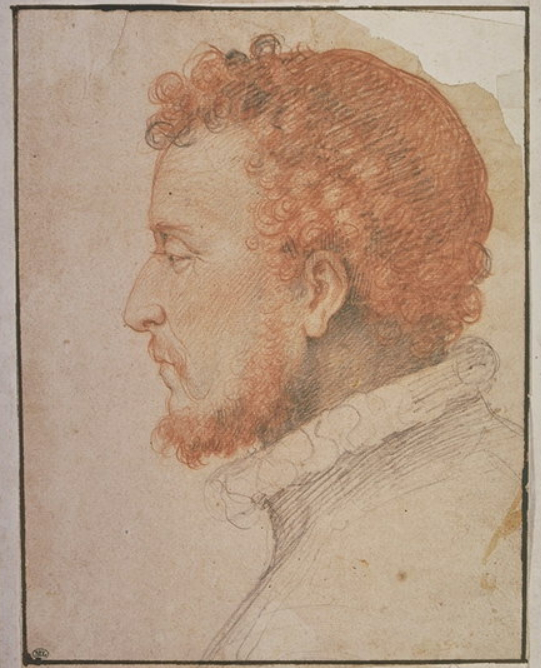
1529–1566
Taddeo Zuccaro, born on September 1, 1529, in Sant'Angelo in Vado within the Duchy of Urbino, emerged from a modest artistic family as the son of the little-known painter Ottaviano Zuccaro, in whose workshop he received his initial training. Encouraged by the local artist Pompeo da Fano, who served briefly as his teacher according to Giorgio Vasari, Taddeo relocated to Rome around age 14, where he largely self-trained by copying the works of masters like Polidoro da Caravaggio and Perino del Vaga. At seventeen, he assisted Daniele da Parma, a pupil of Correggio, on frescoes near Sora, honing his skills in large-scale decoration before launching his independent career.
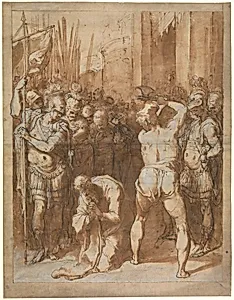
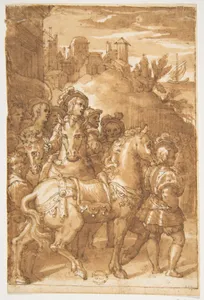
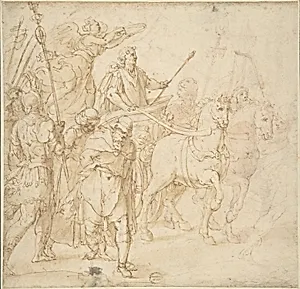
Zuccaro quickly rose to prominence as a fresco painter, securing elite patronage from Popes Julius III and Paul IV, the della Rovere Duke of Urbino, and Roman nobles like Jacopo Mattei. Around 1548, he painted monochrome scenes from the life of Marcus Furius Camillus on the Mattei palace facade, followed by religious frescoes in the Cappella Mattei at Santa Maria della Consolazione (1553–1556), including Scenes of the Passion and the Crucifixion. He collaborated with Prospero Fontana on the Villa Giulia decorations circa 1553, executed the ceiling fresco *The Martyrdom of Saint Paul* in Rome's Frangipani Chapel around 1558, and depicted the Royal Entry of Emperor Charles V into Paris at the Villa Farnese in 1559. From 1559 until his death, he led the grand fresco and stucco program at the Villa Farnese in Caprarola for Cardinal Alessandro Farnese, featuring historical series in *quadro riportato*, as well as Alexander the Great cycles at the Castello Orsini in Bracciano.
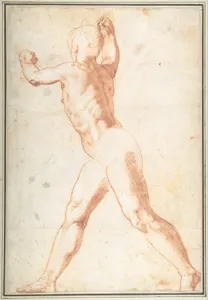
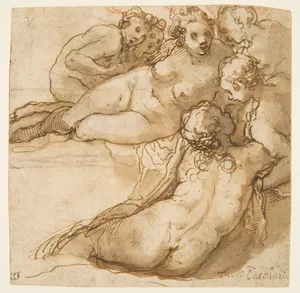
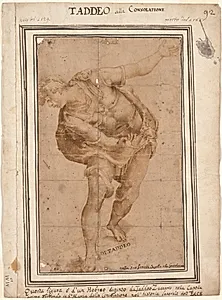
A leading figure in the Roman Mannerist school alongside his younger brother Federico Zuccaro, Taddeo's style fused High Renaissance naturalism with Mannerist elongation, intense emotion, and Michelangelo-inspired muscularity, evident in his fluid, vigorous compositions of heads, hands, and nudes. Vasari lauded his refined technique in vast, often chiaroscuro frescoes executed at breakneck speed for palaces and churches. Dying suddenly on September 2, 1566, in Rome at age 37, he was buried in the Pantheon near Raphael; Federico completed his Farnese projects and later immortalized Taddeo's rags-to-riches saga in a celebrated drawing series. Zuccaro's dynamic decorations, later engraved, cemented his legacy as a bridge between Renaissance grandeur and Mannerist innovation, influencing generations of Roman decorators.
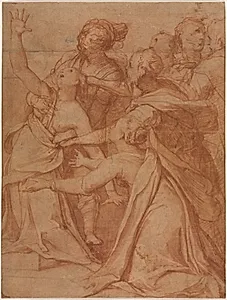
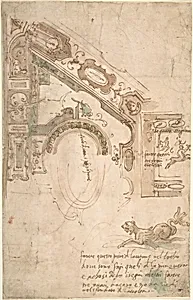
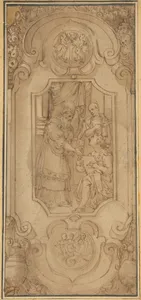
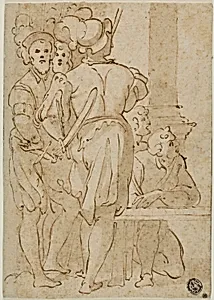
![A Man Seen from Behind [recto]](https://images.artheonmuseum.org/nga/thumb/a-man-seen-from-behind-recto-nga-53111.webp)
![A Man Seen from Behind [verso]](https://images.artheonmuseum.org/nga/thumb/a-man-seen-from-behind-verso-nga-53112.webp)