
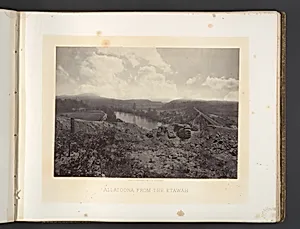
Allatoona from the Etawah
1860s
Medium
Albumen silver print from glass negative
Classification
Photographs
Department
Photographs
Museum
Metropolitan Museum of Art, New York, NY
Credit
Pfeiffer and Rogers Funds, 1970
Accession Number
1970.525 (24)
Rights
Public Domain
Tags
Art Historical Context
George N. Barnard’s “Allatoona from the Etawah,” created in the 1860s, captures a sweeping Southern landscape during one of the most pivotal periods in American history. As a photographer associated with the Union Army’s documentation efforts, Barnard recorded sites connected to the Civil War, including areas around Georgia’s Etowah River and Allatoona Pass. The image reflects the era’s growing use of photography to preserve the visual record of conflict and terrain, offering viewers a quiet yet powerful glimpse into the settings that shaped military campaigns. The work is an albumen silver print made from a glass negative, a technique that allowed for remarkable sharpness and tonal depth in early photography. This medium enabled Barnard to render distant hills, waterways, and forests with clarity, transforming a simple landscape into both an artistic statement and a historical document. Acquired by the Metropolitan Museum of Art through the Pfeiffer and Rogers Funds in 1970, the photograph continues to invite reflection on how images shaped public understanding of the war’s physical and emotional landscape.
About the Artist
George N. Barnard · 1819–present
George N. Barnard (1819–1902) was a pioneering American photographer whose six-decade career spanned the dawn of the medium, from daguerreotypes to Civil War documentation. Born into a farming family in Coventry, Connecticut, on December 23, 1819, he lost his father at age seven and apprenticed in family businesses before marrying in 1843 and relocating to Oswego, New York. There, he launched one ...