
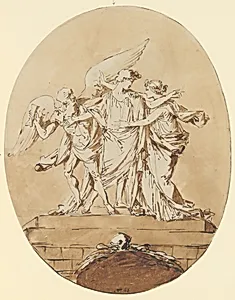
Allegorical Design for a Tomb
n.d.
Medium
Pen and brown ink, brown wash over graphite
Dimensions
oval: 17 5/8 x 14 in. (44.8 x 35.6 cm)
Classification
Drawings
Department
Drawings and Prints
Museum
Metropolitan Museum of Art, New York, NY
Credit
Gift of Alexander B.V. Johnson and Roberta J.M. Olson, in memory of E. Dudley H. Johnson and Laurie Vance Johnson, 2004
Accession Number
2004.489.2
Rights
Public Domain
Tags
Art Historical Context
André Lebrun's *Allegorical Design for a* (n.d.) is a captivating preparatory drawing from 18th-century France, the artist's skill as an architect and ornamental designer. Rendered in pen and brown with brown wash over graphite on an elegant oval sheet (17⅝ × 14 in.), it likely served as a concept for a funerary monument, featuring symbolic male and female figures—perhaps embodying virtues like mourning, eternity, or fame, common in period tomb iconography. The medium exemplifies neoclassical draftsmanship: graphite underdrawing provides precise outlines, while fluid ink lines and subtle brown wash create depth and tonal modeling, evoking sculptural reliefs. This technique was ideal for architectural proposals, allowing Lebrun to convey three-dimensionality on paper for patron approval. Housed in the Metropolitan Museum of Art's Drawings and Prints department, this gifted work (2004) highlights the era's blend of rococo elegance and emerging neoclassicism, offering visitors a window into how elaborate tombs memorialized the elite amid Enlightenment ideals of reason and legacy.