
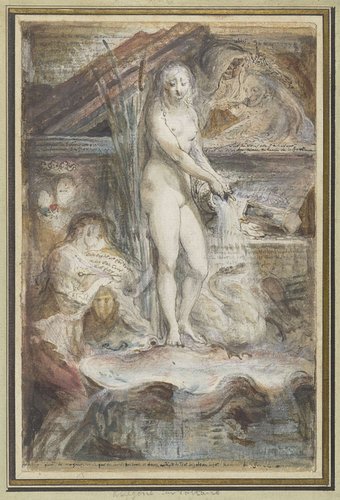
Allegorie op de dood van Voltaire
1778 - 1780
Medium
pen
Dimensions
198; 130
Rights
Public Domain
About this artwork
collector's mark, verso, on the mount, lower centre: Lugt 2228
Art Historical Context
**Allegorie op de Dood van Voltaire** Jacques de Saint-Aubin a prolific French draftsman and engraver active in the Rococo era created this poignant pen drawing between 1778 and 1780. Measuring a modest 198 × mm, it serves as an intimate allegory on the death of Voltaire, the Enlightenment philosopher who passed away in May 1778 at age 83. Saint-Aubin, known for his intricate vignettes and satirical scenes capturing Parisian life, here channels the cultural shockwaves of Voltaire's demise—a figure whose wit and critiques had shaped 18th-century thought. The title, translating to "Allegory on the Death of Voltaire," suggests symbolic imagery mourning or reflecting on the writer's legacy amid controversy; his burial was delayed due to religious opposition, only resolved posthumously. Rendered in pen—likely ink on paper—this technique highlights Saint-Aubin's mastery of fine lines and expressive detail, typical of his fluid, decorative style influenced by the fading Rococo movement toward neoclassicism. Bearing a collector's mark (Lugt 2228) on the verso mount, this small-scale work underscores the era's fascination with ephemeral tributes to luminaries. It invites us to ponder how art immortalized Voltaire's enduring influence on reason and liberty.
About the Artist
Gabriel Jacques de Saint-Aubin · 1724–1780
Gabriel Jacques de Saint-Aubin (14 April 1724 – 14 February 1780) was born in Paris into an artistic family — one of fourteen children of the court embroiderer and engraver G.-G. de Saint-Aubin. Art ran deep in the family: his brothers Charles Germain and Augustin de Saint-Aubin were also accomplished artists. Gabriel received his earliest training at home before entering the studios of Étienne Je...