
Allegorie van Gerechtigheid
1637 - 1639
Medium
pen
Dimensions
152; 104
Rights
Public Domain
About this artwork
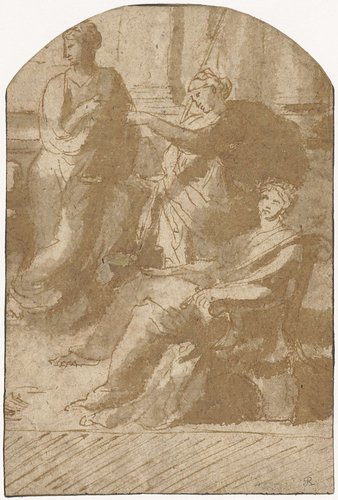
Zittende vrouwenfiguur met staf, geflankeerd door twee staande vrouwen.
Art Historical Context
Nicolas Poussin, the preeminent French artist of the 17th century and a master of classical Baroque style, created *Allegorie van Gerecht* (Allegory of Justice) between1637 and 1639. This intimate pen drawing, measuring just 152 mm high by 104 mm wide, depicts a female figure holding a stafflikely symbolizing Justice herself—flanked by two standing women, evoking the poised dignity of classical virtues. Rendered in precise pen lines, it exemplifies Poussin's meticuloussmanship, honed during his decades in Rome where he drew inspiration from antiquity and Renaissance masters like Raphael. Poussin's works often blended mythological and moral themes with balanced compositions, reflecting the intellectual rigor of his classicism amid the emotional exuberance of the Baroque era. This allegory captures the era's fascination with emblematic justice, a motif popular in royal commissions and emblem books, underscoring virtues essential to absolutist courts like Louis XIII's France. As a preparatory study or standalone sketch, it reveals Poussin's process: starting with linear clarity to build harmony and narrative depth. Though small, this drawing holds artistic significance for its economy of line, inviting viewers to ponder Justice's serene authority. A gem for Poussin enthusiasts, it bridges his grand oil paintings and the intimate world of 17th-century connoisseurship.
About the Artist
Nicolas Poussin · 1594–1665
Nicolas Poussin, born in June 1594 near Les Andelys in Normandy, emerged from a family of local distinction whose modest means and parental opposition could not deter his artistic calling. He received his initial training under the itinerant painter Quentin Varin in Rouen around 1611–12, absorbing lessons in storytelling, precise facial expressions, and rich colors, though without a formal long-te...