
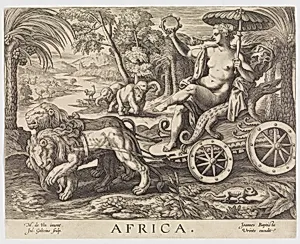
Allegory of Africa, from "The Four Continents"
ca. 1560–90
Medium
Engraving
Dimensions
Sheet: 8 11/16 x 10 7/8 in. (22 x 27.7 cm)
Classification
Prints
Department
Drawings and Prints
Museum
Metropolitan Museum of Art, New York, NY
Credit
The Elisha Whittelsey Collection, The Elisha Whittelsey Fund, 1949
Accession Number
49.95.1526
Rights
Public Domain
Tags
Art Historical Context
In the late 16th century, the height of Northern Renaissance printmaking in Antwerp, *Allegory of Africa* emerged as part of the popular series *The Four Continents*. by the Flemish painter Maerten de Vos, known for his Mannerist style blending intricate detail with symbolic narrative, and masterfully engraved by Julius Gzius, this work personifies Africa as a majestic female figure. Created around 1560–90, it captures Europe's fascination with global exploration, using allegory to evoke the continent's exotic allure amid the Age of Discovery. The composition bursts with vibrant symbolism: a nude or partially draped woman, often riding a chariot pulled by fierce lions or elephants, surrounded by crocodiles and other wild beasts. These elements highlight Africa's untamed wilderness and riches, contrasting with the more civilized depictions of Europe or Asia in the series. As an engraving—a precise intaglio technique where intricate lines are incised into a metal plate for rich tonal depth—this print allowed widespread dissemination of such grand imagery to collectors and scholars. Housed in the Metropolitan Museum of Art's Drawings and Prints department (The Elisha Whittelsey Collection, 1949), this 8 11/16 x 10 7/8 in. sheet exemplifies how prints democratized art, bridging cultural imagination and historical reality for Renaissance audiences.
About the Artist
Julius Goltzius|Maerten de Vos (Netherlandish|Netherlandish) · 1500 |1532 –1595 |1603
Netherlandish, died ca. 1595|Netherlandish, Antwerp 1532–1603 Antwerp