
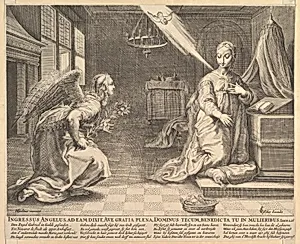
The Annunciation
before 1652
Medium
Engraving
Classification
Prints
Department
Drawings and Prints
Museum
Metropolitan Museum of Art, New York, NY
Credit
Harris Brisbane Dick Fund, 1953
Accession Number
53.601.336(105)
Rights
Public Domain
Tags
Art Historical Context
This engraving captures the pivotal biblical moment of the Annunciation, when the angel Gabriel announces to the Virgin Mary that she will conceive Christ. Created before 1652 by Hendrick Goltzius and Claes Jansz. Visscher, the print reflects the vibrant Dutch printmaking tradition of the early seventeenth century. Goltzius, a leading Northern Mannerist engraver, brought dramatic energy and refined detail to religious subjects, while Visscher, a prominent publisher, helped distribute such works widely across Europe. The medium of engraving allowed artists to achieve remarkable precision through fine, controlled lines incised into copper plates. This technique suited Goltzius’s virtuoso style, enabling intricate textures in the figures’ drapery and ethereal wings that would have resonated with viewers familiar with devotional imagery. As a reproducible art form, engravings like this one played a key role in spreading religious narratives during a period of religious reform and expanding literacy. Housed in the Metropolitan Museum of Art’s collection through the Harris Brisbane Dick Fund, the print underscores the enduring cultural importance of the Annunciation theme. It connects viewers to centuries of Christian iconography while showcasing the technical brilliance that made Dutch prints highly sought after in their time.
About the Artist
Hendrick Goltzius|Claes Jansz. Visscher · 1558–1617
Hendrick Goltzius (1558–1617) was the most celebrated engraver of the Northern Renaissance and a pivotal figure in Dutch Mannerism. Born near the German-Dutch border, Goltzius transformed printmaking into a virtuoso art form through his revolutionary 'swelling line' technique, where the burin was manipulated to create lines of varying thickness that produced unprecedented tonal effects and three-d...