
Allegory of Charity
c. 1743–44
Medium
Oil on canvas
Dimensions
139.5 × 134.6 cm (54 15/16 × 53 in.); Framed: 159.4 × 159.4 cm (62 3/4 × 62 3/4 in.)
Classification
oil on canvas
Department
Painting and Sculpture of Europe
Museum
Art Institute of Chicago
Accession Number
36492
Rights
Public Domain
About this artwork
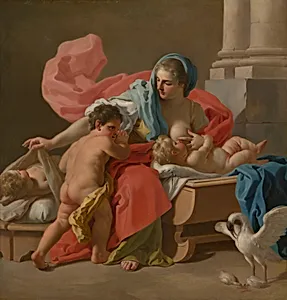
This painting presents an allegory of the virtue of charity through images of maternal love and sacrifice: a mother nurtures several young children and a pelican feeds her young by drawing blood from her own breast. This work was one of a set of allegories of five virtues intended as decorations set above doors in a palace belonging to the king of Savoy, a region in northwest Italy. Francesco de Mura spent most of his career in Naples but also worked for the king of Savoy in the 1740s, producing...
Art Historical Context
Francesco de Mura's *Allegory of Charity painted around 1743–44, is a luminous oil-on-canvas masterpiece from the Neapolitan Roc tradition. Measuring nearly 55 by 53 inches, this work captures the virtue of Charity—typically symbolized by a maternal figure nurturing children or distributing alms—in a swirl of elegant forms and soft, glowing colors. De Mura (1696–1782), a leading painter in 18th-century Naples, inspiration from masters like Luca Giordano, blending dramatic Baroque energy with Rococo's playful grace. The oil medium allowed de Mura to achieve velvety textures and radiant light effects, evident in the diaphanous drapery and tender flesh tones that evoke emotional warmth. Charity's allegorical theme resonated in the Catholic culture of Bourbon Naples, where such virtues adorned churches and palaces, reinforcing moral and spiritual ideals amid the era's artistic splendor. Today, at the Art Institute of Chicago's Department of European Painting and Sculpture, this canvas invites visitors to ponder timeless generosity. Its fluid composition and vibrant palette exemplify Rococo's shift toward intimacy and delight, making it a captivating window into Italy's vibrant 18th-century art world.