
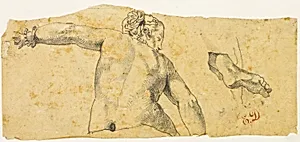
Allegory of Love: Infidelity
n.d.
Medium
Graphite on tan tracing paper, laid down on ivory wove paper
Dimensions
7 × 15.5 cm (2 13/16 × 6 1/8 in.)
Classification
graphite
Department
Prints and Drawings
Museum
Art Institute of Chicago
Accession Number
86321
Rights
Public Domain
Art Historical Context
Eugène Delacroix, towering figure of French Romanticism, captured the tumultuous passions of love in this intimate drawing titled *Allegory of Love:idelity*. Created with graphite on tan tracing paper laid down on ivory w paper, the undated work measures just 7 × 15.5 cm, suggesting it was a preparatory sketch or personal study. Housed in the Art Institute of Chicago's Prints Drawings department, it exemplifies Delacroix's lifelong fascination with allegorical themes, blending emotional intensity with classical motifs. Delacroix's Romantic style shines through in the fluid, expressive lines of graphite, a medium he favored for its versatility in conveying movement and drama. The use of translucent tan tracing paper—often employed for overlays and studies—highlights his innovative techniques, allowing for layered compositions that evoke the fleeting, deceptive nature of infidelity. This small-scale piece reflects the 19th-century Romantic ideal of love as both sublime and destructive, drawing from literary sources like Shakespeare or ancient myths. As a window into the artist's process, *Allegory of Love: Infidelity* reveals Delacroix's genius for distilling grand narratives into delicate drawings, bridging his monumental paintings with private exploration. Visitors will appreciate its poetic tension, a testament to how even sketches can pulse with human emotion.
About the Artist
Eugène Delacroix · 1798–1863
Eugène Delacroix (1798–1863) stands as the defining figure of French Romanticism and a pivotal bridge to modernism. Born in Charenton-Saint-Maurice near Paris, he came from distinguished lineage—his mother descended from the prestigious Oeben-Riesener furniture dynasty, while persistent speculation suggested the statesman Talleyrand may have been his biological father, a theory supported by physic...