
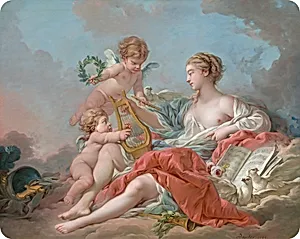
Allegory of Music
1764
Medium
oil on canvas
Dimensions
overall: 103.5 x 130 cm (40 3/4 x 51 3/16 in.) framed: 130.8 x 157.5 cm (51 1/2 x 62 in.)
Classification
Painting
Department
CF
Museum
National Gallery of Art, Washington, D.C.
Credit
Samuel H. Kress Collection
Accession Number
1946.7.2
Rights
Public Domain
Art Historical Context
François Boucher's *Allegory of Music* (1764) captures the playful elegance of the Rococo style, for which the French artist was celebrated. As a favorite painter of Madame de Pompadour and the court of Louis XV, Boucher specialized in mythological and allegorical scenes that blended sensuality with decorative charm. Here, music is personified through graceful figures and instruments, reflecting the era's fascination with the arts as refined pleasures of aristocratic life. Painted in oil on canvas—a medium prized for its luminous color and fluid brushwork—this work exemplifies Boucher's light palette and theatrical compositions. Created during the Enlightenment, when music and the performing arts flourished in Parisian salons, the painting likely served as part of a decorative ensemble celebrating the harmony of the senses. Its generous scale and inviting mood invite viewers to appreciate music not merely as entertainment but as an emblem of cultural sophistication. Today in the National Gallery of Art's collection, *Allegory of Music* offers a delightful window into 18th-century French taste, where art, music, and luxury intertwined.
About the Artist
François Boucher · 1703–1770
François Boucher (1703–1770) stands as the quintessential master of French Rococo painting and the most celebrated decorative artist of the 18th century. Born in Paris to a lace designer, Boucher created a visual language that perfectly embodied the refined taste, sensuality, and elegance of Louis XV's court. His prolific output—encompassing paintings, tapestry designs, theatrical sets, and decora...