
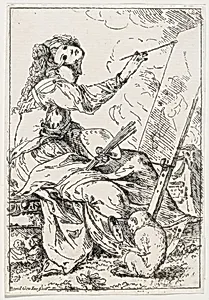
Allegory of Painting
c. 1775/1776
Medium
etching on laid paper
Dimensions
123 × 85 mm (trimmed within platemark)
Classification
Department
CG-E
Museum
National Gallery of Art, Washington, D.C.
Credit
Ailsa Mellon Bruce Fund
Accession Number
2021.66.1
Rights
Public Domain
Art Historical Context
In the National Gallery of Art's Print Department, Giovanni David's *Allegory of Painting* (c. 1775/1776) captivates with its intimate scale—measuring just 123 × 85 mm—and delicate etching on laid paper. This small yet evocative work, acquired through the Ailsa Mellon Bruce Fund, personifies the art of painting through symbolic imagery, a longstanding tradition in European art that honors the muse-like essence of creation. David's etching invites viewers into the late 18th-century fascination with the liberal arts, evoking the elegance of the Enlightenment era. Etching, David's chosen medium, involves drawing acid-resistant lines on a metal plate, allowing the acid to "bite" intricate details that capture subtle textures and tones. Printed on laid paper—a handmade variety with visible chain lines—this technique made fine art accessible to collectors beyond oil paintings. Trimmed close to the platemark, the print emphasizes its precision and portability, ideal for scholarly portfolios. As a classification in prints, *Allegory of Painting* reflects the period's reverence for artistic mastery, blending technical virtuosity with cultural homage. A gem for visitors, it reminds us how such allegories immortalized painting's transformative power.
About the Artist
Giovanni David · 1749–1790
Giovanni David (1743–1790) was a Genoese painter and etcher whose brief career, shaped by distinguished patronage and wide-ranging travel, produced a body of work remarkable for its experimental verve. Born in Genoa, he came under the protection of Count Giacomo Durazzo, a cultivated Genoese nobleman and diplomat who became the defining figure of his artistic life. Durazzo sponsored David's traini...