
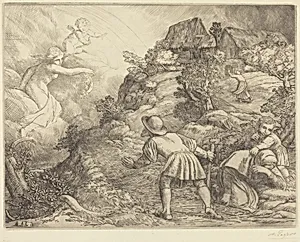
Allegory of the Peasant and Fortune (Le paysan et la fortune: Sujet allegorique
1826 to 1850
Medium
etching and drypoint
Classification
Department
CG-E
Museum
National Gallery of Art, Washington, D.C.
Credit
Gift of George Matthew Adams in memory of his mother, Lydia Havens Adams
Accession Number
1954.15.53
Rights
Public Domain
Art Historical Context
In the National Gallery of Art's collection, Alphonse Legros' *Allegory of the Peasant and Fortune (Le paysan et la fortune: Sujet allegorique)*, created between 1826 and 1850, captures a timeless moral tale through the intimate medium of etching and drypoint. Legros, a French-born artist who later worked in Britain, was renowned for his realist depictions of rural life, drawing inspiration from masters like Rembrandt. This print, gifted by George Matthew Adams in memory of his mother Lydia Havens Adams, exemplifies 19th-century printmaking's revival, blending sharp etched lines with the soft, velvety burr of drypoint for dramatic texture and depth. The allegorical subject—a peasant confronting Fortune—reflects enduring European artistic traditions, symbolizing chance, hardship, and social aspiration amid France's post-Revolutionary era. Peasants often embodied virtue or folly in such fables, commenting on the unpredictability of prosperity in an age of industrialization and class tensions. Legros' technique allowed for nuanced storytelling, with drypoint's rich tonal range evoking emotion in a reproducible yet artisanal form. Housed in the museum's Prints department (CG-E), this work highlights etching's role in democratizing art, making profound narratives accessible beyond oil paintings. Visitors will appreciate its intricate craftsmanship and subtle social insight.
About the Artist
Alphonse Legros · 1837–1911
Alphonse Legros (1837–1911) was born in Dijon, France, and trained in Paris at the drawing school of Horace Lecoq de Boisbaudran, whose unconventional teaching method — which emphasised memory drawing and acute observation over academic convention — would leave a lasting mark on Legros's practice. At Lecoq's school he formed friendships with Jules Dalou and Auguste Rodin that endured throughout hi...