
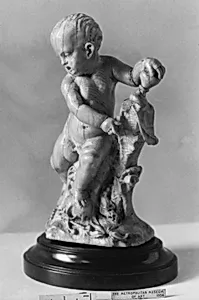
Allegory of Vanity
Unknown Artist
ca. 1725
Medium
Ivory
Dimensions
Height: 4 7/8 in. (12.4 cm)
Classification
Sculpture-Miniature
Culture
German
Department
European Sculpture and Decorative Arts
Museum
Metropolitan Museum of Art, New York, NY
Credit
Bequest of Mary Clark Thompson, 1923
Accession Number
24.80.79
Rights
Public Domain
Tags
Art Historical Context
This exquisite miniature ivory sculpture, *Allegory of Vanity*, by an unknown German artist around 1725, captures the fleeting nature of worldly pursuits in a delicate, pocket-sized form (just 4 7/8 inches tall). Housed in the Metropolitan Museum of Art's Sculpture and Decorative Arts—thanks to the 1923 bequest of Mary Clark Thompson—it exemplifies the era's fascination with moral allegories, where youthful figures, likely boys as suggested by its tags, symbolize vanity's ephemeral allure. Ivory, prized for its creamy translucency and carvability, was a luxury medium in 18th-century Germany, often used for intricate devotional or tabletop objects. Artisans employed fine tools to achieve astonishing detail in these miniatures, blending late Baroque exuberance with emerging Rococo elegance. Such works served as personal reminders of humility amid opulence, reflecting Protestant and Catholic moral teachings prevalent in the Holy Roman Empire. Though the artist's identity remains elusive, the sculpture's technical mastery highlights Germany's renowned ivory workshops, like those in Dresden or Munich. A charming yet poignant piece, it invites visitors to ponder vanity's bubble-like fragility up close.