
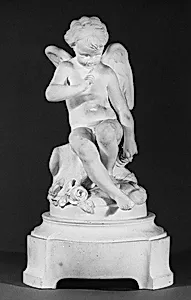
Cupid ("L'Amour Menaçant")
Medium
Soft-paste biscuit porcelain
Dimensions
Height (with stand): 11 7/8 in. (30.2 cm); Height (without stand): 9 1/16 in. (23 cm)
Classification
Ceramics-Porcelain
Culture
French, Sèvres
Department
European Sculpture and Decorative Arts
Museum
Metropolitan Museum of Art, New York, NY
Credit
Gift of Mr. and Mrs. Charles Wrightsman, 1970
Accession Number
1970.230.3a, b
Rights
Public Domain
Tags
Art Historical Context
This delicate yet dynamic figure of *Cupid ("L'Amourenaçant")*, created around 1761 by the Sèvres Manuf with modeling by sculptor Étienne-Maurice Falcon, embodies the whimsical dangers of love in 18th-century French rococo style. Standing about 9 inches tall (without its stand), the-paste biscuit porcelain captures Cupid in a poised, threatening gesture—bow drawn and arrow aimed—highlighting the god's dual role as both charmer and tormentor. The biscuit technique, unglazed and fired to a matte, marble-like finish, was a Sèvres specialty that elevated porcelain from mere tableware to fine sculpture. Falconet, a leading artist at the royal manufactory under Louis XV, infused the piece with his mastery of fluid forms and expressive anatomy, making it a standout in European decorative arts. This unglazed surface invites touch, emphasizing texture and realism. Housed in the Metropolitan Museum of Art's European Sculpture and Decorative Arts department (gift of Mr. and Mrs. Charles Wrightsman, 1970), it reflects Sèvres' dominance in luxury porcelain, favored by aristocracy for its innovative fusion of artistry and craftsmanship during the Enlightenment era. A true gem for lovers of French elegance!
About the Artist
Sèvres Manufactory|Etienne-Maurice Falconet · 1740–present
The Sèvres Manufactory, one of Europe's premier porcelain producers, was established in 1740 as the Manufacture de Vincennes under the patronage of Queen Marie Leszczyńska, who sought to rival Meissen and Chantilly porcelains with French soft-paste innovations. Initially a private venture, it relocated to Sèvres in 1756 in a purpose-built facility designed by architect Laurent Lindet near Madame d...