
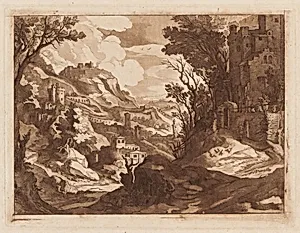
Alpine Landscape
Medium
aquatint and etching printed in brown on laid paper
Dimensions
image: 20.1 × 27.3 cm (7 15/16 × 10 3/4 in.) plate: 22.2 × 29.3 cm (8 3/4 × 11 9/16 in.) sheet: 26.5 × 36 cm (10 7/16 × 14 3/16 in.)
Classification
Department
CG-E
Museum
National Gallery of Art, Washington, D.C.
Credit
Pepita Milmore Memorial Fund
Accession Number
2018.91.32
Rights
Public Domain
Art Historical Context
Created around 1762–1766, *Alpine Landscape* is a delicate aquatint and etching by François-Philippe Charpentier after an original composition by the Flemish painter Paul Bril. Working in the mid-eighteenth century, Charpentier translated Bril’s dramatic mountain vista into print form, using the recently developed aquatint process to suggest the soft gradations of light and atmosphere found in painted landscapes. Printed in warm brown ink on laid paper, the work captures rugged peaks, winding paths, and distant valleys with a tonal subtlety rarely achieved in earlier etching techniques alone. Paul Bril, active in Rome during the late sixteenth and early seventeenth centuries, helped establish the Italianate landscape tradition that would influence generations of artists. By reproducing one of Bril’s designs more than a century later, Charpentier participated in a growing European interest in making celebrated compositions available to collectors who could not travel to see the originals. The aquatint medium, which Charpentier helped refine, allowed printmakers to mimic the fluid effects of wash drawings, bridging the gap between painting and the more linear look of traditional engravings. Measuring roughly eight by eleven inches within the plate, this impression from the National Gallery of Art’s collection exemplifies how eighteenth-century printmakers expanded public access to earlier artistic achievements while showcasing technical innovation. The result is both a faithful homage to Bril’s vision of nature’s grandeur and a quiet demonstration of aquatint’s expressive possibilities.