
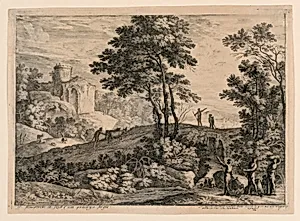
The Bridge Under the High Road
17th century
Classification
Department
Smithsonian Collection
Museum
Smithsonian American Art Museum
Credit
Smithsonian American Art Museum
Accession Number
1896-31-36
Rights
Public Domain
About this artwork
Research in Progress
Art Historical Context
**The Bridge Under the High Road** Henri Mauperthé (French, ca. 1602–1686) Nestled in the Smithsonian American Art Museum's collection, *The Bridge Under the High Road* is a captivating 17th-century print by French engraver Henri Mauperthé. This work likely depicts a scenic architectural vista—a bridge tucked beneath an elevated roadway—evoking the everyday engineering marvels of rural France during the Baroque era. Mauperthé, active in Paris, specialized in detailed topographic views, blending precise observation with artistic elegance to document landscapes and structures that defined the period's growing fascination with travel and the built environment. As a print, the artwork exemplifies a revolutionary medium of its time, enabling affordable reproduction and wide dissemination of images beyond elite circles. Though the exact technique awaits further research, such prints were often etched or engraved on metal plates, allowing intricate lines to capture texture, light, and depth. They served not just as art but as visual records, influencing cartography, tourism, and later landscape painting movements. Today, this piece invites visitors to ponder the interplay of human ingenuity and nature, a timeless theme. Ongoing scholarly efforts promise deeper insights into its creation, making it a hidden gem for print enthusiasts exploring 17th-century Europe's visual culture. (198 words)