
Alto Saxhorn in E-flat
Unknown Artist
ca. 1850–60
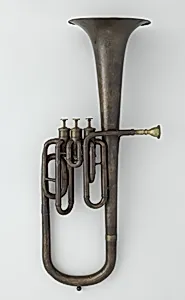
Medium
Brass, nickel-silver
Dimensions
L. 64.4 cm (25-3/8 in.); Diam. of bell: 19.1 cm (7-1/2 in.)
Classification
Aerophone-Lip Vibrated
Culture
possibly French
Department
Musical Instruments
Museum
Metropolitan Museum of Art, New York, NY
Credit
The Crosby Brown Collection of Musical Instruments, 1889
Accession Number
89.4.2177
Rights
Public Domain
Art Historical Context
Step into the resonant world of 19th-century brass innovation with this elegant Alto Saxhorn in E, crafted around 1850–60.ed from gleaming brass and durable nickel-silver, it measures 64.4 cm in length with a bell diameter of 19.1 cm, making it a compact yet powerful member of the aerophone family—specifically lip-vibrated instruments where the player's buzzing lips produce sound through valves and tubing. Its possibly French origins reflect the era's craftsmanship, blending functionality with ornate design typical of European instrument makers. The saxhorn emerged in the mid-19th century as part of a revolutionary family of valved brass instruments, popularized for military bands and orchestras. This example captures the transitional period when such horns transformed music-making, enabling chromatic scales and greater tonal range for ensemble playing. Though the artist remains unknown, the instrument's construction highlights advanced metalworking techniques, with nickel-silver providing corrosion resistance for reliable performance. Housed in the Metropolitan Museum of Art's Crosby Brown Collection of Musical Instruments (acquired 1889), this piece offers a tangible link to the Romantic era's musical evolution, inviting visitors to imagine its vibrant role in lively concert halls and parades of yore.