
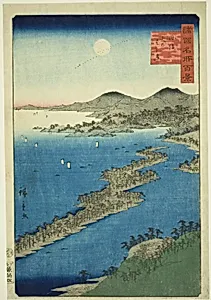
Amanohashidate in Tango Province (Tango Amanohashidate), from the series "One Hundred Famous Views in the Various Provinces (Shokoku meisho hyakkei)"
Medium
Color woodblock print; oban
Classification
woodblock print
Department
Arts of Asia
Museum
Art Institute of Chicago
Accession Number
26683
Rights
Public Domain
Art Historical Context
Welcome to the Art Institute of Chicago's Arts of Asia collection, where you'll find *Amanohashidate in Tango Province (Tango Amanohidate), a stunning 1859 color woodblock print by Uawa Hiroshige IIShigenobu). Part of the series *One Hundred Famous Views in Various Provinces (Shok meisho hyak)*, this oban work continues the legacy ofshige I, his master, capturing Japan's most celebrated landscapes during the late Edo period. manohashidate, a pine-covered sandbar in what was then Tango Province (modern-day Kyoto Prefecture), is one of Japan's "Three Most Scenic Views." Hiroshige II masterfully renders its sweeping curve against a vast sea and sky, evoking a sense of serene wonder. This meisho-e (famous places) print reflects ukiyo-e's focus on transient beauty, blending precise observation with poetic atmosphere to transport viewers to distant natural wonders. Printed using traditional woodblock techniques—carved blocks inked in vibrant colors and layered by hand—this piece highlights the collaborative artistry of Edo-period Japan. Produced amid growing foreign influences, it preserves a fading world of isolation, offering timeless insight into Japanese aesthetics and wanderlust. A true gem for lovers of landscape art!
About the Artist
Utagawa Hiroshige II (Shigenobu) · 1826–1869
Utagawa Hiroshige II, born Suzuki Chinpei in 1826, was one of the most accomplished ukiyo-e artists of mid-nineteenth century Japan. He entered the studio of the celebrated landscape master Utagawa Hiroshige I — known for his iconic series "The Fifty-three Stations of the Tokaido" — and proved himself the most talented of the elder artist's few students. So highly regarded was the young pupil that...