
Amerapoora: Pyee-dyk Kyoung
September 1–October 21, 1855
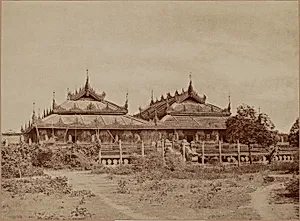
Medium
albumen print
Dimensions
image/sheet: 25.1 × 34.2 cm (9 7/8 × 13 7/16 in.) mount: 45.6 × 58.3 cm (17 15/16 × 22 15/16 in.)
Classification
Photograph
Department
CPH
Museum
National Gallery of Art, Washington, D.C.
Credit
Edward J. Lenkin Fund
Accession Number
2012.87.22
Rights
Public Domain
Art Historical Context
**Amerapoora: Pyee-dyk Kyoung** Linnaeus Tripe, 1–October 21, 1855* Albumen print; image/sheet: 25.1 × 34.2 cm (9 7/8 × 13 7/16 in.); mount: 45.6 × 58.3 cm (17 15/16 × 22 15/16 in.) National Gallery of Art,, D.C. Edward J. Lenkin Captured by British photographer Linnaeuspe during his 1855 mission to Burma (modern-day Myanmar), this albumen print depicts Pyee-dyk Kyoung, a striking Buddhist monastery in Amarapura. Tripe, serving as the East India Company's official photographer, documented the region's ornate teakwood architecture amid towering spires and intricate carvings—a testament to Burmese craftsmanship in the mid-19th century. His work arrived at a pivotal moment, following the Second Anglo-Burmese War, preserving sites that blended spiritual devotion with royal patronage. The albumen print medium, coated with egg whites for exceptional clarity and warm tones, revolutionized photography in the 1850s, allowing Tripe to render fine details like weathered wood and rhythmic rooflines with remarkable fidelity. Larger than many contemporaries, this print's scale on its mount invites viewers to immerse in the scene's serene grandeur. As one of Tripe's Burmese series, it holds historical significance, offering a rare colonial-era glimpse into Southeast Asian heritage before modernization altered these landscapes. A window to a fading world, it celebrates photography's power to safeguard cultural memory.
About the Artist
Linnaeus Tripe · 1822–1902
Linnaeus Tripe (1822–1902), born in Devonport, England, as the ninth of twelve children to Mary and Cornelius Tripe, pursued a military career influenced by his sister Emily's marriage to an army colonel. Joining the East India Company's Madras Infantry as a cadet in 1838, he rose to lieutenant in southern India by 1840 and captain in Bangalore by 1854. Extended leave in England from 1850 due to i...