
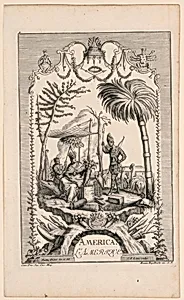
America
Medium
Classification
Department
Smithsonian Collection
Museum
Smithsonian American Art Museum
Credit
Museum purchase through gift of Anonymous Donor
Accession Number
1947-43-1
Rights
Public Domain
About this artwork
Research in Progress
Art Historical Context
**America** (1717) is a captivating print by Martin Engelbrecht, a prolific German engraver from Augsburg (1684–1756), now housed in the Smithsonian American Museum. Created during the early 18th century, this exemplifies Engelbrecht's specialty in producing affordable, hand-colored prints that brought allegorical imagery to a wide audience. Likely part of his renowned series personifying the four continents,America* depicts the New World as a symbolic female figure adorned with feathers, indigenous motifs, and exotic attributes—reflecting Europe's romanticized and exoticized view of the Americas amid ongoing colonial expansion. In the historical context of 1717, Europe was still buzzing from tales of exploration by figures like Columbus and later voyagers, fueling a cultural obsession with global geography. Engelbrecht's print captures this zeitgeist through Baroque-era allegory, blending satire and grandeur in intricate line work and vibrant coloring typical of his mezzotint and etching techniques. These methods allowed for rich tonal depth and mass production, making high art accessible beyond elite patrons. As a museum highlight from the Smithsonian Collection—acquired via an anonymous donor's gift—this piece invites visitors to ponder how early modern prints shaped perceptions of distant lands, bridging art, cartography, and imperialism in an engaging snapshot of 18th-century imagination. (198 words)