
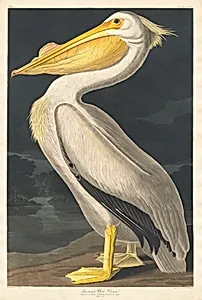
American White Pelican
Medium
hand-colored engraving and aquatint on Whatman wove paper
Dimensions
image: 89.54 × 60.01 cm (35 1/4 × 23 5/8 in.) plate: 97 x 64.8 cm (38 3/16 x 25 1/2 in.) sheet: 100.4 x 67.6 cm (39 1/2 x 26 5/8 in.)
Classification
Department
CG-W
Museum
National Gallery of Art, Washington, D.C.
Credit
Gift of Mrs. Walter B. James
Accession Number
1945.8.311
Rights
Public Domain
Art Historical Context
The presents a striking American White Pelican standing in profile on a rocky shore. Its tall white body fills much of the vertical composition, balanced by a massive yellow-orange bill and pouch, a small crest of pale feathers at the back of the head, and bright yellow webbed feet. Delicate shading defines the layered wing feathers and soft texture of the plumage, while a dark, atmospheric background of water and distant trees heightens the bird’s luminous form. This hand-colored engraving and aquatint was produced by Robert Havell after John James Audubon in 1836. It belongs to Audubon’s celebrated series that portrayed North American birds at life-like scale, combining precise observation with dramatic natural settings. The resulting prints helped introduce a wide audience to the continent’s wildlife through both scientific detail and artistic grandeur.
About the Artist
Robert Havell after John James Audubon
Robert Havell Jr., born on November 25, 1793, in Reading, Berkshire, England, was the son of renowned engraver and publisher Robert Havell Sr. and Lydia Miller Phillips. Growing up in a family of artists that included notable engravers and etchers, he trained under his father, mastering aquatint techniques early on. Though briefly estranged from the family business, Havell reconciled with his fath...