
Amélie Laurent Dieterlé
c. 1899
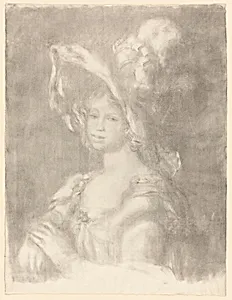
Medium
Lithograph in gray on off-white wove paper
Dimensions
Image: 53.6 × 40.6 cm (21 1/8 × 16 in.); Sheet: 53.6 × 40.6 cm (21 1/8 × 16 in.)
Classification
lithograph
Department
Prints and Drawings
Museum
Art Institute of Chicago
Accession Number
110095
Rights
Public Domain
Art Historical Context
Pierre-Auguste Renoir *Amélie Laurent Dieterlé* (c. 1899) captures the essence of a poised young woman in a delicate lithograph, rendered in soft grays on off-white w paper. Measuring 21⅛ × 16 inches, this intimate portrait reflects Renoir's Impressionist roots, even as he ventured into printmaking late in his career. By 1890s, the French master—famous for luminous oil paintings of Parisian life—was exploring lithography to make his work more accessible, blending his signature loose brushwork with the medium's fluid lines and tonal subtleties. Lithography, invented in the late 18th century, allowed Renoir to draw directly on a stone with greasy crayon, creating velvety textures and subtle gradations that mimic his painted strokes. This technique democratized art, producing multiples from a single image, though Renoir's prints retained a painterly intimacy. Housed in the Art Institute of Chicago's Prints and Drawings department, the work showcases his enduring fascination with female subjects, evoking the grace and warmth of everyday beauty amid fin-de-siècle France. Visitors will appreciate how *Amélie Laurent Dieterlé* bridges Renoir's Impressionist vibrancy with the refined reproducibility of prints, offering a window into his evolving artistry.
About the Artist
Pierre-Auguste Renoir · 1841–1919
Pierre-Auguste Renoir (1841-1919) was a founding figure of Impressionism whose luminous depictions of Parisian leisure, sensuous female forms, and sun-dappled landscapes made him one of the most beloved painters in Western art history. Born in Limoges to a working-class family, Renoir began as a porcelain painter before pursuing fine arts, and this early craft experience gave him facility with the...