
Ammon and Jonadab
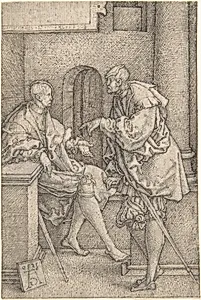
Medium
Pen and brown and black ink.
Dimensions
Overall: 4 5/8 x 3 1/16 in. (11.7 x 7.8 cm)
Classification
Drawings
Department
Drawings and Prints
Museum
Metropolitan Museum of Art, New York, NY
Credit
The Elisha Whittelsey Collection, The Elisha Whittelsey Fund, 1950
Accession Number
50.605.1
Rights
Public Domain
Tags
Art Historical Context
In the intimate world of Renaissance drawings, *Ammon and Jonad* (1539) by Heinrichegrever stands as delicate gem. Crafted in pen and brown and black ink on a modest 4 5/8 x 3 1/16 inches sheet, this work exemplifies the German artist's mastery of fine line work. Aldegrever, a prominent figure among the "Little Masters" of Northern Renaissance printmaking, was known for his intricate engravings of biblical scenes, portraits, and genre subjects, often produced in his workshop in Soest, Westphalia. This drawing, housed in the Metropolitan Museum of Art's Drawings and Prints department, likely served as a preparatory study, showcasing his precise, economical technique that translated seamlessly to copper plates. The title evokes the biblical narrative from 2 Samuel 13, depicting Ammon (often spelled Amnon) and his cousin Jonadab in a moment of intrigue amid familial tragedy. Aldegrever's choice reflects the era's fascination with Old Testament stories as moral exemplars during the Reformation, when Protestant humanism encouraged direct engagement with scripture. The use of varied ink tones adds subtle depth and modeling to the male figures—tagged simply as "Men"—highlighting expressive faces and dynamic poses that convey tension and conspiracy. As part of The Elisha Whittelsey Collection, this piece invites visitors to appreciate the humility of drawings: humble yet profound precursors to Aldegrever's influential prints, bridging personal sketchwork with widespread cultural dissemination in 16th-century Europe.
About the Artist
Heinrich Aldegrever · 1502–1561
Heinrich Aldegrever, born in 1502 in Paderborn, Westphalia, to parents Herman and Katherine Trippenmeker—a family of clog-makers known by the dialect name Trippenmecker—emerged as a multifaceted artist in the German Renaissance. His early training remains undocumented, though he likely apprenticed in a Soest goldsmith's workshop after relocating there around 1525, where he joined the painters' gui...