
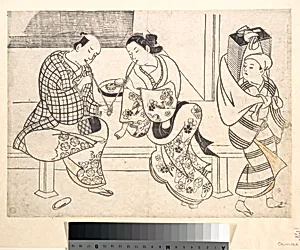
Amorous Couple
early 18th century
Medium
Monochrome woodblock print; ink and color on paper
Dimensions
10 3/8 x 14 in. (26.4 x 35.6 cm)
Classification
Prints
Culture & Period
Japan · Edo period (1615–1868)
Department
Asian Art
Museum
Metropolitan Museum of Art, New York, NY
Credit
The Francis Lathrop Collection, Purchase, Frederick C. Hewitt Fund, 1911
Accession Number
JP683
Rights
Public Domain
Tags
Art Historical Context
**Amorous Couple** by Okura Masanobu invites visitors into the vibrant "floating world" of early 18th-century Edo Japan (1615–1868). This intimate woodblock print, rendered in monochrome ink and subtle color on paper (10 3/8 x 14 in.), captures a tender moment between lovers, accompanied by a young boy and hints of everyday leisure like smoking. Masanobu, a masterfulkiyo-e pioneer, expertly blends sensuality with urban life, evoking the pleasure districts of Edo (modern Tokyo). Masanobu's innovation shines in his early color printing techniques, such as *urushi-e* (lacquer-print) and *benizuri-e* (rose-colored prints), which added glossy depth and limited hues to traditional monochrome designs. These methods bridged single-color *sumizuri-e* and the full-spectrum *nishiki-e* that later defined ukiyo-e masters like Hiroshige and Hokusai. His works democratized art, making scenes of romance, theater, and daily pleasures accessible to commoners. Housed in the Metropolitan Museum of Art's Asian Art collection (Francis Lathrop Collection, 1911), this print reflects Edo Japan's cultural exuberance—where woodblocks fueled a print boom, blending eroticism (*shunga* influences) with social observation. A delightful window into fleeting joys!
About the Artist
Okumura Masanobu · 1686–1764
Japanese, 1686–1764