
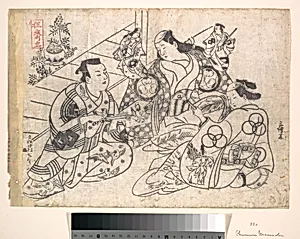
Scene from a Drama
1710–13
Medium
Woodblock print; ink and color on paper
Dimensions
10 3/8 x 13 27/32 in. (26.4 x 35.2 cm)
Classification
Prints
Culture & Period
Japan · Edo period (1615–1868)
Department
Asian Art
Museum
Metropolitan Museum of Art, New York, NY
Credit
Rogers Fund, 1918
Accession Number
JP550
Rights
Public Domain
Tags
Art Historical Context
Step into the vibrant world of Edo-period Japan with *Scene from a Drama* (1710–13), a captivating woodblock print by Okura Masanobu. One of the pioneering masters of ukiyo-e "pictures of the floating world"—Masanobu captured the theatrical spectacles that enthralled urban audiences in early 18th-century Tokyothen Edo). This print likely depicts a lively kabuki or bunraku, featuring actors in elaborate costumes, graceful women (possibly onnagata male performers in female roles), and intricate puppets, blending human drama with puppetry's artistry. Masanobu's innovative use of woodblock printing with ink and vibrant colors on paper revolutionized accessible art. Printed in multiple colors via separate blocks—a technique he helped popularize—this 10 3/8 x 13 27/32 in. sheet allowed mass production for a growing merchant class. The dynamic composition, with expressive poses and rich patterns, highlights his skill in hosoban (half-sheet) format, making theater scenes intimate yet immersive. Housed in the Metropolitan Museum of Art's Asian Art Department (Rogers Fund, 1918), this print reflects Edo Japan's cultural boom, where theater was a social phenomenon. It offers a window into fleeting pleasures—love, rivalry, and spectacle—that defined ukiyo-e's enduring appeal.
About the Artist
Okumura Masanobu · 1686–1764
Japanese, 1686–1764