
Amphora
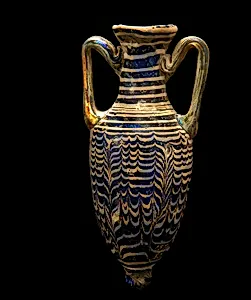
Medium
Decorative Arts-Glass
Classification
Decorative Arts-Glass
Department
Smithsonian Collection
Museum
Smithsonian American Art Museum
Credit
Smithsonian American Art Museum, Gift of John Gellatly
Accession Number
1929.8.157.20
Rights
Public Domain
About this artwork
Most of the glass vessels in this case date from the first century BC to the fourth century AD. Early glass vessels were made in the Middle East and Egypt using the core-forming technique, in which molten glass was poured over a clay core and decorated with threads of colored glass. During the first century AD, Rome became the center of glassmaking, and the invention of blown glass led to new methods, including free-blown glass, which could be decorated by pinching, rolling, or dragging the surf...
Art Historical Context
This elegant Roman glass amphora part of the Smithsonian American Art's collection, exemplifies the of ancient glassmaking from the first century BC to the fourth AD. Gifted by John Gellatly, it hails from a time when Rome emerged as the epicenter of the craft, transforming everyday vessels into objects of beauty and utility. Amphorae like this were essential for storing wine, oil, or other goods, but their glass counterparts showcased technical innovation and aesthetic flair. Early Roman glass began with the core-forming technique—molten glass draped over a clay core and adorned with colorful threads—before the revolutionary invention of glassblowing around the first century AD. This enabled free-blown forms, pinched or trailed decorations, mold-blown patterns, stratified layers of fused colored canes, and the dazzling millefiori ("thousand flowers") method, where sliced glass rods created floral mosaics. Many such vessels, including this amphora, were buried in wealthy Roman tombs, where centuries of damp soil contact weathered the surface into a shimmering iridescence, enhancing their otherworldly allure today. As a decorative arts treasure, this amphora highlights Rome's mastery in blending function with fine art, bridging Middle Eastern origins and imperial innovation for posterity.