
Amputation
February 17, 1786
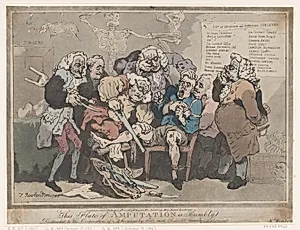
Medium
Hand-colored etching
Dimensions
Sheet: 11 in. × 14 7/16 in. (28 × 36.6 cm)
Classification
Prints
Department
Drawings and Prints
Museum
Metropolitan Museum of Art, New York, NY
Credit
The Elisha Whittelsey Collection, The Elisha Whittelsey Fund, 1959
Accession Number
59.533.89(b)
Rights
Public Domain
Tags
Art Historical Context
**Amputation** is a hand-colored etching created by the renowned British caricaturist Thomas Rowlandson in collaboration with William Hinton, February 17, 6. Measuring 11 x 14 7/16 inches, this satirical print belongs to the Metropolitan Museum of's Drawings and Prints department, part of The Elisha Whittelsey Collection.son, a master of 18th-century caricature, often teamed up with engravers like Hinton to produce vivid social commentaries that poked fun at human folly. The artwork falls squarely within the Georgian era's tradition of satirical prints, using exaggerated scenes of men undergoing "punishment" through amputation to lampoon crude medical practices or quackery. Hand-coloring, a key technique here, heightened the visual impact, making the grotesque humor pop with bold hues and drawing viewers into the chaos. These affordable etchings circulated widely in London taverns and shops, critiquing everything from botched surgeries to societal vices. Rowlandson's irreverent style captured the era's tensions between emerging medicine and public skepticism, offering a darkly comic lens on pain and folly. Today, it reminds us how art served as a mirror—and scalpel—to 18th-century life, blending laughter with sharp cultural critique. (198 words)
About the Artist
Thomas Rowlandson|William Hinton · 1756–1827
Thomas Rowlandson (1757–1827) was an English artist and caricaturist whose satirical watercolors and prints captured the social life of Georgian Britain with unparalleled wit and technical mastery. Alongside James Gillray, he is recognized as one of the greatest British graphic artists, and his distinctive flowing line and keen observations have made his work integral to understanding late 18th an...