
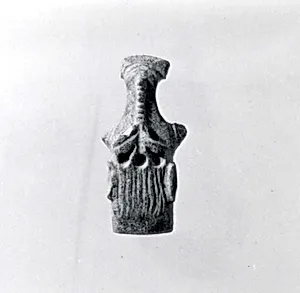
Amulet
Unknown Artist
ca. 1st century BCE
Medium
Lapis lazuli
Dimensions
1 in. (2.54 cm)
Classification
Stone-Ornaments
Department
Ancient Near Eastern Art
Museum
Metropolitan Museum of Art, New York, NY
Credit
Dodge Fund, 1949
Accession Number
49.40.10
Rights
Public Domain
Art Historical Context
This delicate lapis lazuli am, crafted around the 1st century, hails from the Ancient Near East and exemplifies the region's enduring tradition of protective jewelry. Measuring just 1 inch (2.54 cm), it was likely worn as a personal talisman, strung on a cord or necklace to safeguard its owner from evil spirits, misfortune, or disease—a common practice in Mesopotamian, Persian, and cultures during the late Hellenistic era. Lapis lazuli, a vibrant deep-blue stone sourced primarily from Afghanistan's Badakhshan mines, held immense symbolic value in antiquity. Revered as a celestial material akin to the night sky or lapis-colored hair of gods in Sumerian myths, it was reserved for elite objects, from royal seals to divine statues. Carving such a small piece demanded exquisite precision, highlighting the skilled lapidaries who transformed raw nodules into potent amulets through grinding, polishing, and incising. Acquired through the Dodge Fund in 1949, this ornament now graces the Metropolitan Museum of Art's Ancient Near Eastern collection, offering a window into the spiritual worldview of a world where everyday adornments blurred the line between fashion, faith, and fortune. Visitors are invited to marvel at its timeless sparkle and the ancient hopes it once embodied.