
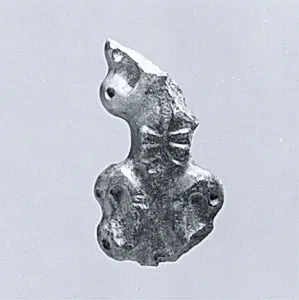
Harness or bridle fitting (?)
Unknown Artist
ca. 9th century BCE
Medium
Shell
Dimensions
1.5 x 0.87 x 0.59 in. (3.81 x 2.21 x 1.5 cm)
Classification
Shell-Equestrian
Culture & Period
Iran · Iron Age II, Hasanlu Period IV
Department
Ancient Near Eastern Art
Museum
Metropolitan Museum of Art, New York, NY
Credit
Rogers Fund, 1965
Accession Number
65.163.52
Rights
Public Domain
Art Historical Context
This delicate shell fitting, possibly from a horse harness or bridle, hails from Iron Age II Iran during the Hasanlu Period IV around the 9th BCE. Discovered in the ancient Near East, it reflects the equestrian culture of northwest Iran, where horses played a vital role in warfare, trade and elite status. Excavated from the Hasanlu site—a richly destroyed citadel—this tiny artifact (just 1.5 inches long) offers a glimpse into a turbulent era of tribal conflicts and emerging Iron Age technologies. Crafted from shell, a lightweight yet durable material prized for its natural luster and workability, the fitting showcases the skilled carving techniques of ancient Iranian artisans. Shell was often incised or polished to create functional yet decorative equestrian gear, blending utility with subtle artistry. Its classification as "Shell-Equestrian" underscores the period's innovation in horseback riding accessories, which enhanced mobility across the rugged Iranian plateau. Acquired through the Rogers Fund in 1965, this piece now resides in the Metropolitan Museum of Art's Ancient Near Eastern Art department. Though its exact form is uncertain (noted by the question mark in its title), it embodies the ingenuity of a forgotten world, inviting us to ponder the daily lives of Iron Age riders.