
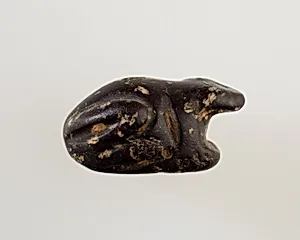
Amulet, frog
Unknown Artist
Medium
Porphyry
Dimensions
Height: 1.3 x 2.7 cm (1/2 x 1 1/16 in.)
Classification
Amulet, frog
Period
Third Intermediate Period–Late Period
Department
Egyptian Art
Museum
Metropolitan Museum of Art, New York, NY
Credit
Gift of Helen Miller Gould, 1910
Accession Number
10.130.1929
Rights
Public Domain
Tags
Art Historical Context
This delicate frog amulet, carved porphyry—a prized hardstone revered in ancient Egypt for its durability and rich purple hue—measures just 1.3 x 2.7 cm, small enough to wear as jewelry or place in a tomb. Dating to the Third Intermediate Period through the Late Period (ca. 1070–332 B.C.), it exemplifies the Egyptians' masterful miniaturist tradition, where tiny sculptures packed profound symbolic power. Frogs held deep cultural significance in ancient Egypt, often linked to, rebirth, and the Nile's life-giving floods. As amulets, these frog forms were believed to protect the wearer, invoke the frog-headed goddess Heqet (patron of childbirth and creation), or ensure regeneration in the afterlife. Crafted with precise carving techniques suited to the unforgiving stone, such objects were mass-produced yet personalized for daily or funerary use. Now in the Metropolitan Museum of Art's Egyptian Art collection, thanks to a 1910 gift from Helen Miller Gould, this amulet invites us to ponder the ancient Egyptians' blend of artistry and spirituality—reminding us that even the smallest artifacts carried the weight of eternity.