
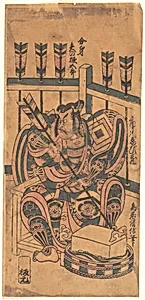
An Actor Portrait (Wears a Danjuro Mon)
Medium
Woodblock print; ink and color on paper
Dimensions
5 3/4 x 12 1/2 in. (14.6 x 31.8 cm)
Classification
Prints
Culture
Japan
Department
Asian Art
Museum
Metropolitan Museum of Art, New York, NY
Credit
Gift of Mrs. Francis Ormond, 1949
Accession Number
JP3156
Rights
Public Domain
Tags
Art Historical Context
Torii Kiyonobu I's *An Actor Portrait (Wears Danjuro Mon)* captures the vibrant world of Edo-period kabuki theater in Japan. Created as a woodblock print with ink and color on paper this intimate work measures just 5 3/4 x 12 1/2 inches, typical of early ukiyo-e designs meant for affordable, widespread enjoyment. The title highlights the actor's distinctive Danjūrō mon—a heraldic crest associated with the prestigious Ichikawa Danjūr lineage of kabuki performers—signaling star power and theatrical prestige. As a master of the Torii school, Kiyonobu I (active early 1700s) pioneered yakusha-e, or actor prints, that brought the drama of kabuki stages to everyday viewers. These prints immortalized performers in dynamic poses, blending bold lines, vivid colors, and expressive faces to convey movement and personality. Tags like "Men," "Actors," and "Arrows" suggest a scene rich with props, evoking the high-energy aragoto style of heroic roles popularized by Danjūrō actors. This piece, now in the Metropolitan Museum of Art's Asian Art collection (gift of Mrs. Francis Ormond, 1949), exemplifies how ukiyo-e democratized art, fueling Japan's "floating world" of entertainment and celebrity culture during the 18th century. Visitors will appreciate its lively spirit, a window into theater's enduring allure.
About the Artist
Torii Kiyonobu I · 1664–1729
Torii Kiyonobu I (1664–1729), born Shōbei in Osaka, was the second son of Torii Kiyomoto, a prominent kabuki actor specializing in onnagata roles and a painter of theater signboards. He studied painting under his father as well as Yoshida Hanbei and Hishikawa Moronobu, the pioneering ukiyo-e master whose figure styles profoundly shaped his early work. In 1687, at age twenty-four, Kiyonobu accompan...