
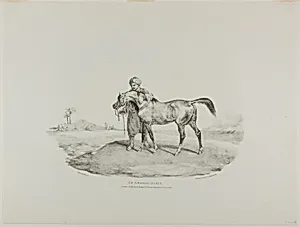
An Arabian Horse, plate 8 from Various Subjects Drawn from Life and on Stone (The English Suite)
March 1821
Medium
Lithograph in black on ivory wove paper
Dimensions
Image: 17 × 33.5 cm (6 3/4 × 13 1/4 in.); Sheet: 37.7 × 49.5 cm (14 7/8 × 19 1/2 in.)
Classification
lithograph
Department
Prints and Drawings
Museum
Art Institute of Chicago
Accession Number
121980
Rights
Public Domain
Art Historical Context
In the bustling artistic scene of early 19th-century France, Théodore Géric, a leading figure of Romanticism, created *An Arabian Horse*, plate8 from his groundbreaking series *Various Subjects D from Life and on Stone*—affectionately known as *The English Suite*. Produced in March 1821 during Géricault's time in England, this lith captures his fascination with equine anatomy and dynamic movement, themes central to his oeuvre, including his iconic *Raft of the Medusa*. The series reflects his immersion in British sporting culture and equestrian life, blending raw realism with dramatic energy. Printed in bold black ink on ivory wove paper, this lithograph measures a compact 17 × 33.5 cm for the image, showcasing lithography's revolutionary potential—a technique Géricault helped pioneer in fine art. Invented just two decades earlier, lithography allowed artists like him to draw directly on stone with greasy crayon, producing rich tonal contrasts and fluid lines that mimic charcoal sketches. This medium democratized detailed reproductions, making Géricault's vivid portrayals of horses accessible beyond oil paintings. Géricault's *Arabian Horse* exudes power and nobility, its muscular form rearing with restrained ferocity—a nod to the exotic allure of Oriental breeds in European imagination. Housed in the Art Institute of Chicago's Prints and Drawings department, it exemplifies how Géricault bridged French Romantic passion with English precision, influencing generations of animaliers and printmakers.
About the Artist
Jean Louis André Théodore Géricault · 1791–1824
Jean-Louis André Théodore Géricault (1791–1824) was born into a prosperous bourgeois family in Rouen, France, the son of a lawyer who managed the family tobacco business. After moving to Paris around 1797, his artistic talent emerged early, nurtured in a circle that included his maternal uncle Jean-Baptiste Caruel and art dealer Jean-Louis Laneuville. Géricault began formal training in 1808 under ...