
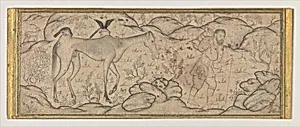
An Emaciated Horse Led by His Master
Unknown Artist
late 16th century
Medium
Ink and watercolor on paper
Dimensions
H. 2 1/8 in. (5.4 cm) W. 5 3/8 in. (13.7 cm)
Classification
Codices
Department
Islamic Art
Museum
Metropolitan Museum of Art, New York, NY
Credit
Bequest of George D. Pratt, 1935
Accession Number
45.174.11
Rights
Public Domain
Tags
Art Historical Context
This delicate ink and watercolor painting on paper, titled *An Emaciated Horse by His Master*, hails from the late th century and exemplifies the exquisite miniature tradition of Islamic art. Measuring just 2⅛ by 5⅜ inches, it likely originates from a codex—an illuminated manuscript book—where such tiny, intricate scenes were nestled among pages of text. Housed in the Metropolitan Museum of Art Department of Islamic Art (Bequest of George D., 1935), it captures a poignant moment: a gaunt horse guided by its master, accompanied by birds, evoking themes of loyalty, hardship, and the human-animal bond. In the vibrant world of Persian or Ottoman manuscript illustration during this era, artists mastered fine-line ink work and subtle watercolor washes to convey narrative depth on minuscule scales. The emaciated horse, rendered with empathetic precision, highlights the technical virtuosity of these anonymous creators, who layered translucent pigments for lifelike texture and emotion. Such codices often illustrated poetry, histories, or moral tales, blending realism with symbolic resonance—horses symbolizing nobility, their frailty underscoring life's transience. This artwork invites visitors to marvel at its intimacy: hold it close, and a story unfolds in strokes finer than a whisper, bridging 16th-century courts to our modern gaze.