
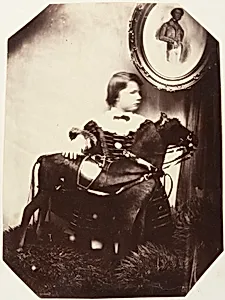
An "Enfant terrible" (No One Can Do the Impossible)
Medium
Albumen silver print from paper negative
Dimensions
Image: 8 11/16 × 6 1/2 in. (22.1 × 16.5 cm) Sheet: 13 3/8 × 18 1/8 in. (34 × 46 cm)
Classification
Photographs
Department
Photographs
Museum
Metropolitan Museum of Art, New York, NY
Credit
Gilman Collection, Gift of The Howard Gilman Foundation, 2005
Accession Number
2005.100.372.4
Rights
Public Domain
Tags
Art Historical Context
In the mid-1850s, French photographer Louis-Pierre-Théophile Dubois de Nehaut captured the playful spirit of childhood in *An "Enfant terrible" (No One Can Do the Impossible)*, an albumen silver print made from a paper negative. This technique, rooted in the calotype process pioneered by William Henry Fox Talbot, used a translucent paper negative to produce richly detailed positives coated in egg-white albumen for superior tonal range and permanence. At 8 11/16 × 6 1/2 inches, the image exemplifies early photography's shift from daguerreotypes to more reproducible paper-based methods, allowing wider dissemination of intimate portraits. The title evokes a mischievous "enfant terrible"—a naughty child defying limits—with tags suggesting a boy posing with toys and a horse, perhaps a hobby horse in a whimsical, impossible feat. Created during photography's formative years, when studios staged domestic scenes to appeal to bourgeois families, this work highlights the medium's ability to freeze fleeting moments of joy and rebellion, blending portraiture with narrative charm. Housed in the Metropolitan Museum of Art's Gilman Collection, this print underscores photography's rapid evolution from novelty to art form, preserving 19th-century ideals of childhood innocence amid industrial change. Visitors will delight in its timeless humor and technical finesse.
About the Artist
Louis-Pierre-Théophile Dubois de Nehaut · 1799–1872
Louis-Pierre-Théophile Dubois de Nehaut (1799–1872) was a French artist and early enthusiast of photography whose career bridged the worlds of traditional draughtsmanship and the new mechanical image-making technologies that transformed visual culture in the nineteenth century. Trained in the conventions of French academic art, he possessed the skills of a practiced draughtsman before turning his ...