
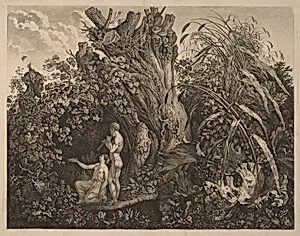
An Offering to Pan
c. 1810
Medium
etching on laid paper
Dimensions
plate: 42.3 x 53.2 cm (16 5/8 x 20 15/16 in.) sheet: 45.5 x 56.3 cm (17 15/16 x 22 3/16 in.)
Classification
Department
CG-E
Museum
National Gallery of Art, Washington, D.C.
Credit
Gift of Ruth Cole Kainen
Accession Number
2012.92.331
Rights
Public Domain
Art Historical Context
Carl Wilhelm Kolbe's *An Offering to Pan*c. 1810) is a captivating etching on laid paper, the spirit of early 19th-century Romantic through its mythological theme. Kolbe, a skilled German engraver and etcher (1757–1835), specialized in intricate landscapes and classical subjects, drawing inspiration from ancient Greek lore. Here, the scene evokes a ritual tribute to Pan, the horned god of the wild, shepherds, and untamed nature—perfectly aligning with Romantic ideals of emotion, the sublime, and humanity's connection to the natural world. Rendered in etching, a technique where acid etches fine lines into a copper plate for precise, expressive detail, the work measures an impressive plate size of 42.3 x 53.2 cm. Laid paper, with its textured chain lines, was a favored support for fine prints, enhancing the tactile quality when inked and pulled. This medium allowed Kolbe to achieve atmospheric depth and delicate foliage, making the print both intimate and grand. Housed in the National Gallery of Art's Prints department (a gift of Ruth Cole Kainen), *An Offering to Pan* reflects the era's revival of classical mythology amid Napoleonic turbulence, offering viewers a timeless escape into pastoral fantasy. A gem for print enthusiasts, it showcases how etching democratized art, inviting all to ponder Pan's eternal allure.