
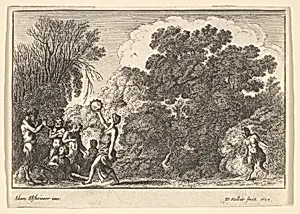
Five satyrs and two nymphs
Medium
Etching, only state
Dimensions
Plate: 2 13/16 × 3 15/16 in. (7.1 × 10 cm)
Classification
Prints
Department
Drawings and Prints
Museum
Metropolitan Museum of Art, New York, NY
Credit
Purchase, Joseph Pulitzer Bequest, 1917
Accession Number
17.50.18-244
Rights
Public Domain
Tags
Art Historical Context
This delicate etching captures a lively mythological scene of five satyrs and two nymphs gathered among trees, evoking the playful yet sensual spirit of classical antiquity. Created in 1650 as an etching in its only state, the work measures just over three inches wide, inviting close, intimate viewing. Adam Elsheimer, a pioneering German artist known for his small-scale paintings rich in dramatic light and narrative detail, likely supplied the original composition. Wenceslaus Hollar, a skilled Bohemian printmaker active in England, translated it into this fine etching, preserving the design for wider audiences. Prints like this played a vital role in 17th-century Europe by disseminating artistic ideas across borders at a time when original paintings remained rare and expensive. The medium allowed precise lines and subtle textures to render foliage, expressive figures, and woodland settings with remarkable clarity. Though modest in size, the work reflects the enduring Baroque fascination with mythological themes drawn from Ovid and other ancient sources, blending humor, movement, and natural detail to delight viewers. Acquired by the Metropolitan Museum of Art in 1917 through the Joseph Pulitzer Bequest, this print exemplifies how reproductive etchings helped keep Elsheimer’s inventive spirit alive long after his death.
About the Artist
Adam Elsheimer|Wenceslaus Hollar · 1578–1610
Elsheimer's meticulously detailed small paintings on copper would establish him as the most influential artist to follow Albrecht Dürer. He most likely arrived in Italy ca. 1598, where he quite possibly was associated with Hans Rottenhammer, and then moved to Rome in 1600, where he remained until his death. Comment on works: Landscapes; Religious.