
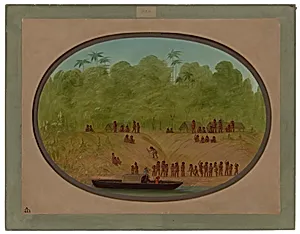
An Omagua Village - Boat Sketch
1854/1869
Medium
oil on card mounted on paperboard
Dimensions
overall: 47.5 x 62.9 cm (18 11/16 x 24 3/4 in.)
Classification
Painting
Department
CAB
Museum
National Gallery of Art, Washington, D.C.
Credit
Paul Mellon Collection
Accession Number
1965.16.280
Rights
Public Domain
Art Historical Context
George Catlin's *An Omagua Village - Boat Sketch* (1854/1869) captures a fleeting glimpse of indigenous life along the Amazon River, reflecting the artist's adventurous later career. After documenting North American Native tribes in the 1830s, Catlin journeyed to South America in the 1850s, painting remote groups like the Omagua people—a Tupi-speaking group in the upper Amazon basin. This work, part of his effort to preserve vanishing cultures amid encroaching colonization, embodies his lifelong mission to create an ethnographic record through art. Painted in oil on card mounted on paperboard (47.5 x 62.9 cm), the piece is a preparatory sketch, likely executed swiftly on location from a boat, as suggested by its title. This modest medium allowed portability during Catlin's arduous travels, contrasting his grand studio portraits. The loose, expressive brushwork highlights daily village scenes—canoes, thatched huts, and figures—evoking the vibrant riverine world of the Omagua. Housed in the National Gallery of Art's Paul Mellon Collection, this painting underscores Catlin's Romantic vision of "noble savages," blending documentary precision with dramatic realism. It invites visitors to ponder the cultural exchanges and losses of the 19th century, offering a window into a pre-industrial Amazon.
About the Artist
George Catlin · 1796–1872
George Catlin (1796–1872), born in Wilkes-Barre, Pennsylvania, to Putnam Catlin and Polly Sutton—who had been captured by Native Americans during the 1778 Battle of Wyoming—initially pursued a legal career. Trained at Litchfield Law School, he was admitted to the bar in 1819 but abandoned law after two years to study art in Philadelphia in 1823. Self-taught as a portraitist, Catlin quickly gained ...