Ctrl K
1796–1872
George Catlin (1796–1872), born in Wilkes-Barre, Pennsylvania, to Putnam Catlin and Polly Sutton—who had been captured by Native Americans during the 1778 Battle of Wyoming—initially pursued a legal career. Trained at Litchfield Law School, he was admitted to the bar in 1819 but abandoned law after two years to study art in Philadelphia in 1823. Self-taught as a portraitist, Catlin quickly gained notice for his miniature portraits before turning his gaze westward, inspired by tales of frontier life from his family's visitors and the Lewis and Clark expedition.
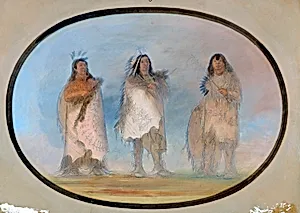
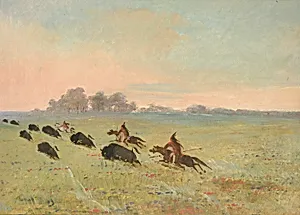
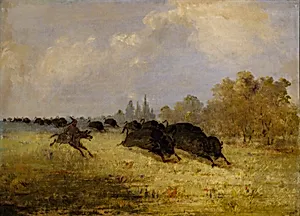
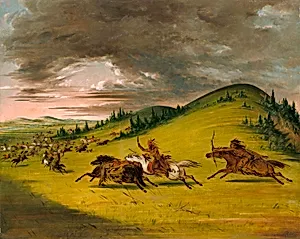
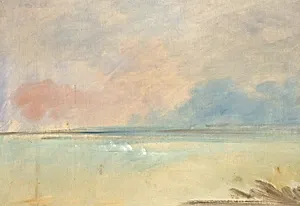
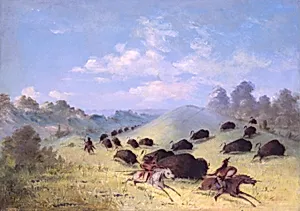
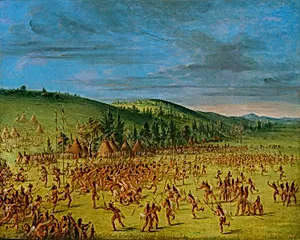
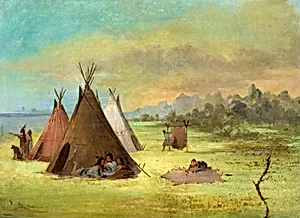
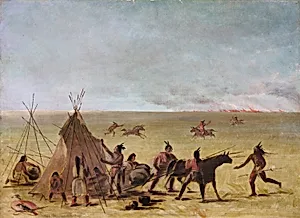
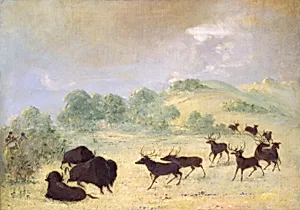
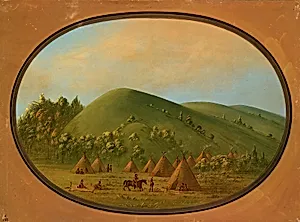
In 1830, Catlin launched his ambitious project, accompanying Governor William Clark up the Mississippi River and embarking on five expeditions across the American West through 1836, ascending the Missouri River over 1,900 miles to Fort Union and visiting tribes including the Mandan, Pawnee, Sioux, and Comanche. He produced over 500 portraits, landscapes, and scenes for his "Indian Gallery," capturing daily life, ceremonies, and warriors with vivid realism. Key works include *Sha-có-pay, The Six, Chief of the Plains Ojibwa* (1832), *Wah-ro-née-sah, The Surrounder, Chief of the Otoe Tribe* (1832), *Comanche Feats of Horsemanship* (1834–1835), and *Wi-jún-jon, Pigeon's Egg Head (The Light), Going To and Returning From Washington* (1837–1839). Touring Europe from 1839, he displayed the gallery in London, Paris, and Brussels, later recreating it after financial losses and expanding to South America in the 1850s.
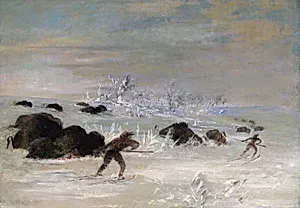
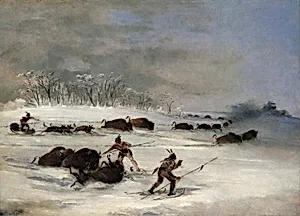
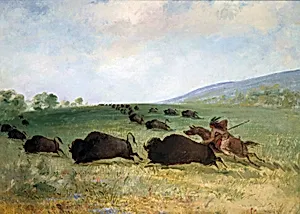
Catlin worked in the tradition of ethnographic portraiture, pioneering documentary art of Plains Indians before their cultures were profoundly altered by American expansion. His style emphasized penetrating likenesses and dynamic action, as in buffalo hunts and rituals like the Mandan O-kee-pa ceremony, blending Romantic vigor with scientific precision. Publications amplified his impact: *Letters and Notes on the Manners, Customs, and Condition of the North American Indians* (1841) and *Catlin's North American Indian Portfolio* (1844).
Catlin's legacy endures through the Smithsonian American Art Museum's near-complete Indian Gallery of over 400 works, donated in 1879, preserving an invaluable visual record of vanishing Native lifeways. Married to Clara Gregory in 1828 (she died in 1845), he advocated for national parks to protect such landscapes, influencing conservation. His 361 known artworks in collections testify to his role as America's first great chronicler of Indigenous frontier life.