
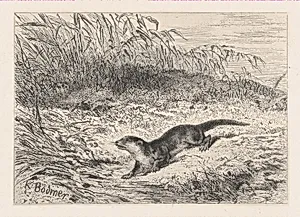
An Otter, from "Eaux-Fortes Animaux & Paysages"
Medium
Etching
Dimensions
Sheet: 7 1/2 × 10 1/4 in. (19 × 26.1 cm) Plate: 4 1/2 × 6 5/16 in. (11.5 × 16 cm)
Classification
Prints
Department
Drawings and Prints
Museum
Metropolitan Museum of Art, New York, NY
Credit
The Elisha Whittelsey Collection, The Elisha Whittelsey Fund, 1959
Accession Number
59.500.467
Rights
Public Domain
Tags
Art Historical Context
This delicate etching, titled *An Otter*, forms part of the mid-nineteenth-century series *Eaux-Fortes Animaux & Paysages* (“Etchings of Animals & Landscapes”). Created around 1860 by Karl Bodmer in collaboration with printers Jules Géruzet and Bertauts, the print exemplifies the period’s growing fascination with natural history and the Romantic appreciation of wildlife. Bodmer, celebrated for his precise observational drawings made during travels in North America, brought the same careful attention to European fauna, capturing the otter’s sleek form with fine, expressive lines. Etching allowed artists to achieve remarkable detail and tonal subtlety, making the medium ideal for scientific illustration as well as artistic expression. Measuring just 4½ by 6⅜ inches within the plate, the work invites close viewing, rewarding the eye with textures that evoke the animal’s wet fur and the rippling water around it. Acquired by the Metropolitan Museum in 1959 as part of the Elisha Whittelsey Collection, the print preserves a moment when art and natural science converged to celebrate the beauty of the animal world.
About the Artist
Karl Bodmer|Jules Géruzet|Bertauts · 1809–1893
Johann Carl Bodmer was born on February 11, 1809, in Zürich, Switzerland, and received his training as a painter and engraver under his uncle Johann Jakob Meier, who had himself studied under the prominent engraver Heinrich Füssli. By the late 1820s Bodmer had relocated to Koblenz, Germany, where his work came to the attention of Prince Maximilian zu Wied-Neuwied, a German naturalist-explorer plan...