
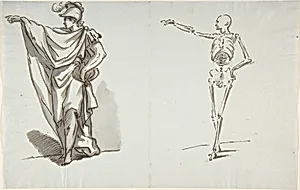
Anatomical drawing
18th century
Medium
Pen and ink, brush and gray wash on blue paper
Dimensions
sheet: 8 7/16 x 13 1/8 in. (21.4 x 33.4 cm)
Classification
Drawings
Department
Drawings and Prints
Museum
Metropolitan Museum of Art, New York, NY
Credit
Gift of Jenny Philippsohn, in memory of Siegfried Philippsohn, 1954
Accession Number
54.580.3
Rights
Public Domain
Tags
Art Historical Context
This anatomical drawing from 18th-century France captures the human skeleton with remarkable clarity and precision. Created pen and ink with delicate gray washes on blue paper, the work highlights the structure of male figures in various positions, reflecting the era’s growing interest in scientific observation. The cool blue ground provides a subtle contrast that makes the skeletal forms stand out, demonstrating the artist’s skillful use of light and shadow to convey volume and depth. During the Enlightenment, anatomical studies like this one served both artistic and educational purposes. French artists and medical students alike relied on such drawings to understand the body’s underlying framework, moving beyond surface appearances to explore movement and proportion. Though the creator remains anonymous, the sheet exemplifies the period’s blend of artistic training and empirical inquiry. Housed in the Metropolitan Museum’s Department of Drawings and Prints, this work offers a quiet window into 18th-century curiosity about the human form. Its modest scale and careful technique invite viewers to appreciate the beauty found in scientific accuracy.
About the Artist
Anonymous, French, 18th century · 1700–1800
The artist known as Anonymous, French, 18th century, represents a collective of unidentified talents active roughly between 1700 and 1800, a period of profound artistic evolution in France from the opulent Rococo to the austere dawn of Neoclassicism and Revolutionary fervor. Little is documented about their personal training or mentors, as their anonymity obscures individual biographies, though th...